Blog
Rethinking Focus in the Classroom: Movement, Sound and Doodling
It's independent work time, and in theory the room should be quiet. In practice, one student's foot is bouncing, someone else is doodling while listening, and soft music is playing in the back row.
Maybe a little voice pipes up right away: can anyone actually work like this? Most of us grew up believing that focus looks still. And while you're answering questions, handing out materials and already planning the next lesson in your head, every bit of movement in the room feels like one more thing to manage.
That reflex makes complete sense. Still, I've seen it again and again: movement and attention aren't opposites, and sometimes that bouncing foot is exactly what keeps a student on task.

Focus doesn't always look still
Neurodivergent describes differences in how people perceive, think, learn and process the world around them, and those differences look different in every student.
For some students, movement helps them keep their attention on a demanding task. Students with ADHD performed better when they moved more, though that's a correlation, not proof that it works for every individual. With fidget spinners, a very small study of three students found more visible on-task behavior, but that's no more than a cautious hint.
Sound affects people very differently. Some students need a steady background sound to work well, while others lose their way into the task the moment there's noise. For autistic students, sounds, light and touch can make focusing even harder.
Then there are side activities: small actions that happen alongside the actual work, like doodling, quietly squeezing putty, or an inconspicuous hand movement. They can support attention, but they aren't automatically helpful, which is exactly why they deserve a closer look.
A tip you can try tomorrow: six steps to rethink focus in your classroom
-
1. Allow quiet movement
For work periods, agree on a few low-key options, like a bouncing foot, a resistance band on the chair or a standing spot. Movement stays allowed as long as it doesn't put anyone at risk or pull attention away from the learning goal. Afterward, look together at whether it's really helping the work.
-
2. Plan short movement breaks
Break up longer stretches with a clear bit of movement: the class fetches books, stretches, or takes a quick walk. Announce when it starts and when it ends, and a visible timer or a single sentence gives everyone their bearings.
-
3. Treat sound separately from the task
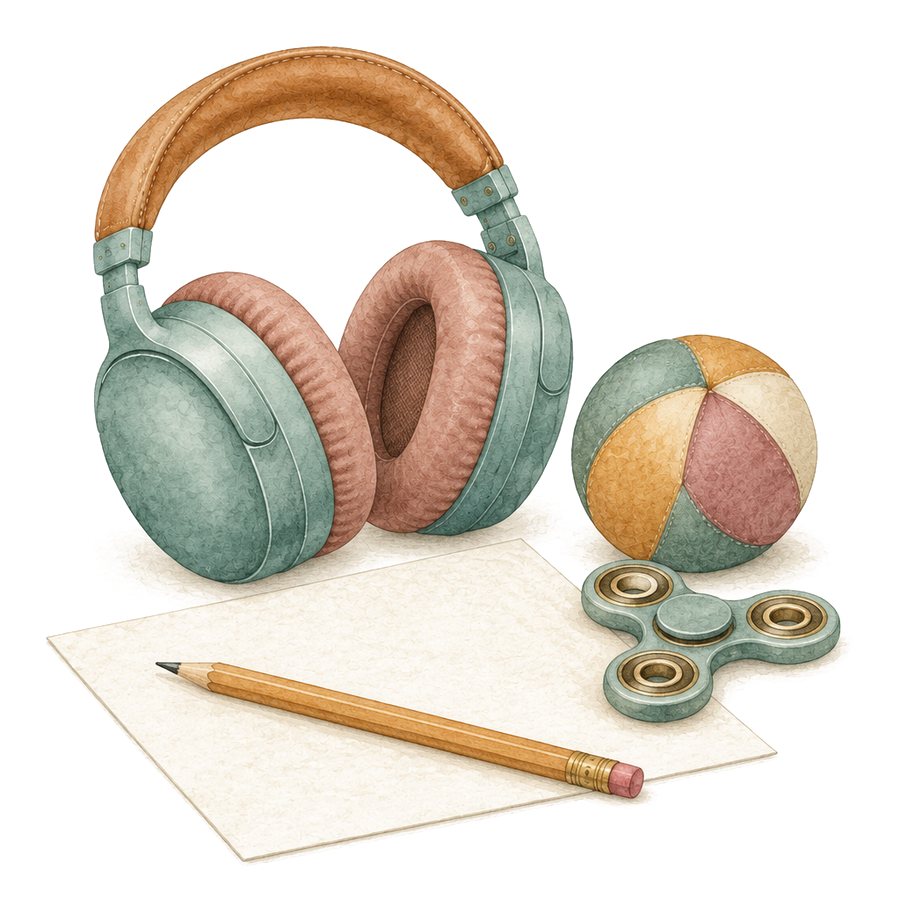
During independent work, offer a quieter option, such as ear protection, headphones without speech, or a spot with less background noise. Music isn't a universal focus tool, so if you allow it, agree on volume, length and content beforehand.
-
4. Give side activities a clear limit
Allow doodling in the margin or quiet squeezing while students listen, and decide when hands need to be free. During a science experiment, for example, a side activity might block the view of the materials, and then you offer something else.
-
5. Make the choices visible
Write three options on the board: “I'm sitting,” “I'm standing,” and “I'm moving my feet,” plus one option for sound and one for quiet. Students choose without having to explain themselves in front of the class.
-
6. Judge the effect by the learning goal
Don't look only at posture. Check whether the task is understood, worked on and finished. After the work period, ask: “What helped you stick with it?” Then change one thing and look again.

What can go wrong
A still body isn't automatic proof of attention, and no single tool works for everyone: movement or sound that helps one student can bother another. To keep a fidget tool from turning into a toy, choose one with no lights, no sound and no eye-catching movement.
Music can drown out speech, so leave it off during important explanations. Noise protection can also leave a student out without meaning to, so agree on when they need to listen or respond.
Two things matter a lot to me here. Any solution is an offer: it's voluntary and it's allowed to change. And observations aren't a diagnosis. Describe the situation, the task and the effect, without turning it into a label.
You don't have to change everything at once
I know how full your days are, and between grading, meetings and parent conferences there's not much room for new ideas. So start small: in one work period, allow one extra option and see what happens.
It often becomes clear pretty quickly who benefits and who would rather work in total silence, and both are fine. When students get to think about what helps them, the whole class shares a piece of the responsibility, and you no longer have to keep an eye on everything by yourself.
Related topic pages in the Teacher Portal
For the background, take a look at the topic pages on ADHD, autism and sensory sensitivity.
For questions about how students process sound, the page on auditory processing disorder is a good fit. The topic pages explain why these supports might work for your students.

Download: “My Focus Helper”
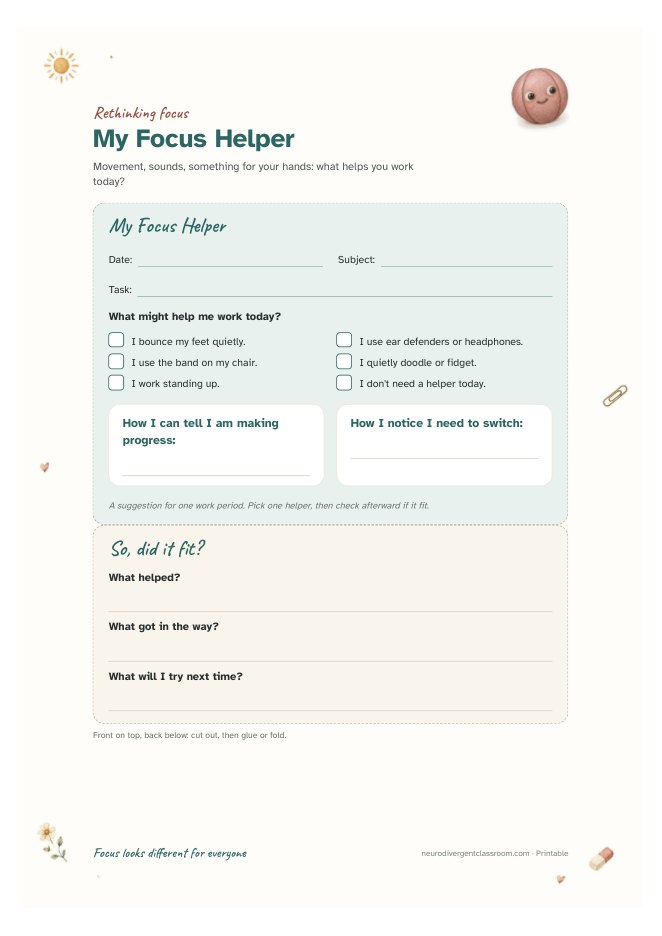
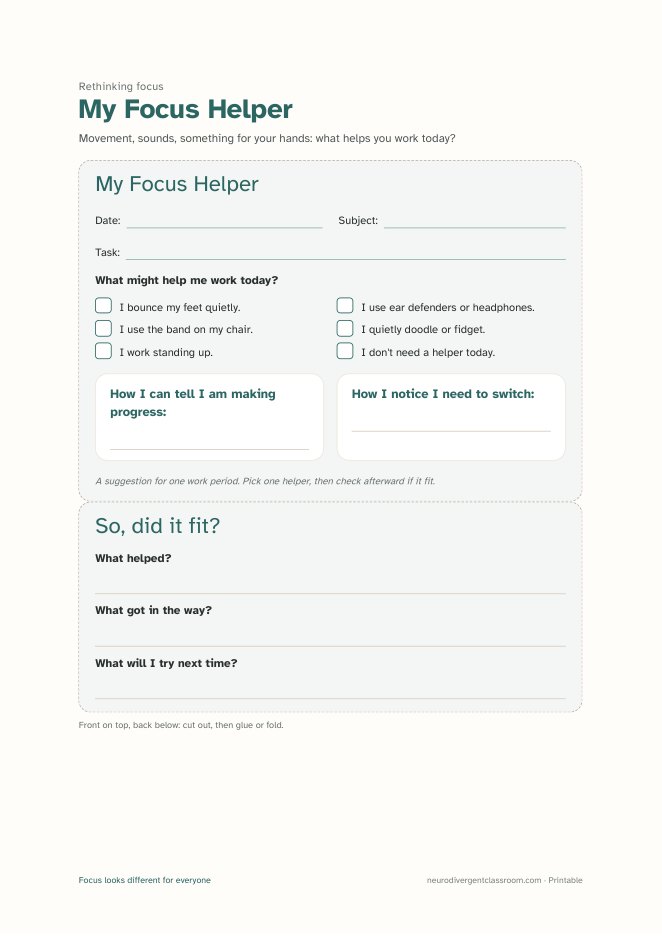
With this card, students pick one support to try before a work period: quietly bouncing their feet, the resistance band on the chair, working standing up, ear protection or headphones, doodling, or squeezing putty. “I don't need a helper today” is a perfectly good choice too. Two boxes invite students to notice their own progress and to recognize when something needs to change. On the back are three short questions for calmly looking back at what helped, what got in the way, and what they'll try next time. The card has no names and no diagnoses on it, so you can simply hand it to the whole class.
Every printable comes in a colorful and a simple version. Choose the one you like to work with. Click the image to open the printable.
And one just for you
A page to take a breath and write things down, no lesson planning involved.
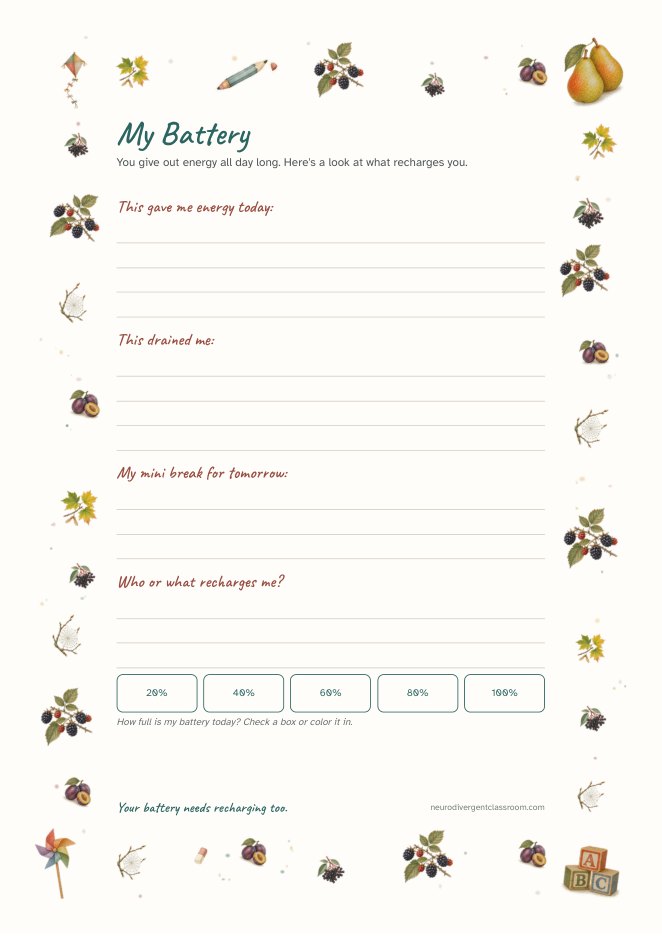
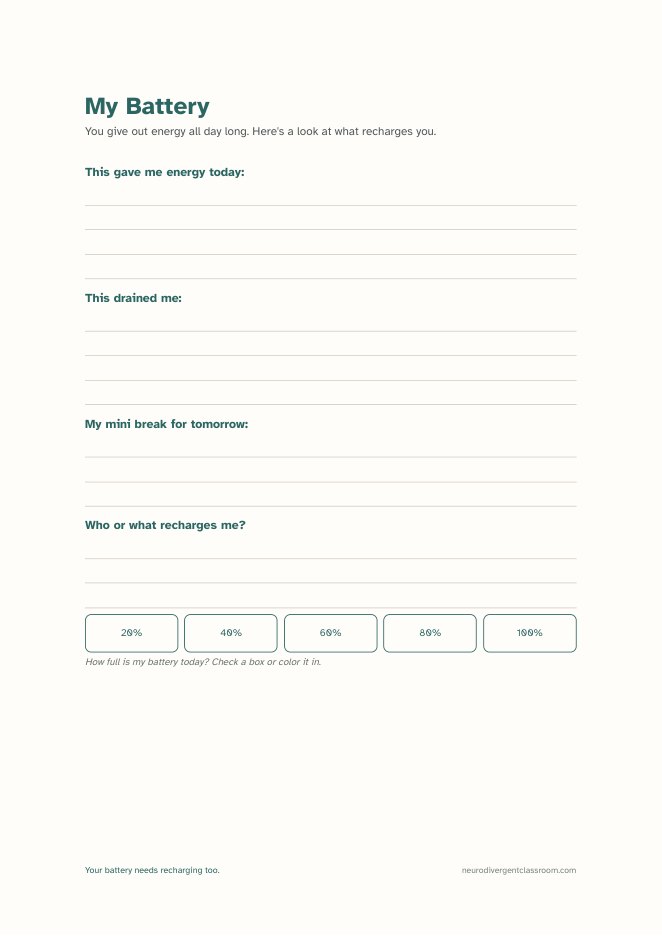
You will find these and all other printables collected in the Teacher Portal (members only).
A quiet class and a focused class aren't always the same thing, and it's the focused one you're allowed to look for.
Sources
- Hartanto, Lewis, and Schweitzer: Don’t Stop the Movement!, CHADD, accessed October 14, 2026.
- Aspiranti, K. B. and Hulac, D. M. (2022): Using fidget spinners to improve on-task classroom behavior for students with ADHD. Behavior Analysis in Practice, 15(2), 454 to 465, accessed October 14, 2026.
- National Autistic Society: Reasonable adjustments for autistic pupils’ sensory differences, reviewed June 6, 2025, accessed October 14, 2026.