Blog
Reducing Classroom Noise: Five Quiet Signals That Really Work
Group work is going well, really well. Everyone's into it, there's discussion and laughter and a bit of friendly arguing, and ten minutes in it's so loud that nobody can hear their own partner. You call out “Quieter, please!” and realize in that very moment that yours is the loudest voice in the room.

I know those moments, and I know the days when they stack up: a pile of tests waiting at home, parent conferences around the corner, and by evening a voice that feels scratchy and worn. On days like that, classroom noise isn't just the class's problem. It's yours too.
So instead of one more rule you have to enforce with everything you've got, here are a few quiet signals that take work off your plate. They show everyone what comes next, without adding to the noise.

Why classroom noise is more than an annoyance
We all know noise wears us out, but for students it matters even more: kids need better listening conditions than adults to understand speech. What sounds like ordinary background chatter to us can mean that part of your explanation simply never reaches them.
Background speech is especially disruptive. When the next table is talking, it's harder to read a text and remember what you've read, and students with language or attention difficulties are hit harder than others. Students with dyslexia often find it especially hard to pick speech out of background noise, too; studies show that many of them understand speech in noise less well than in quiet. That isn't true for every student, but for many, a calmer room makes a noticeable difference. At the same time, there's no need to panic, because the measurable effects are usually small. The goal isn't to ban every sound. A calmer room simply makes learning easier for a lot of students.
Some autistic students find it hard to filter out background noise. For them, a classroom can feel like a radio playing every station at once, and sudden loud sounds can hit hard, even when they barely show it.
And then there's you. High noise levels and echoey rooms are a real risk to teachers' voices. If you're hoarse by evening, that's not a sign of weakness. It means you've spent the whole day talking over the noise. The American Speech-Language-Hearing Association (ASHA) also notes that talking in a loud classroom strains a teacher's voice and can lead to voice problems.

Why a noise meter alone rarely does the trick
Plenty of classrooms have a traffic-light noise meter, and the idea behind it is a good one. It shows that it's loud, but not what to do about it, and by the time it flashes red, the moment when a calm signal would still have worked has often passed.
Quiet signals kick in earlier. You practice them when things are calm, and they announce the next step, which makes your teaching more predictable. A predictable environment gives students a sense of control, and the ones who struggle most with noise can relax a little when they know it's about to get quieter and how they'll be able to tell.

A tip you can try tomorrow: five quiet signals for reducing classroom noise
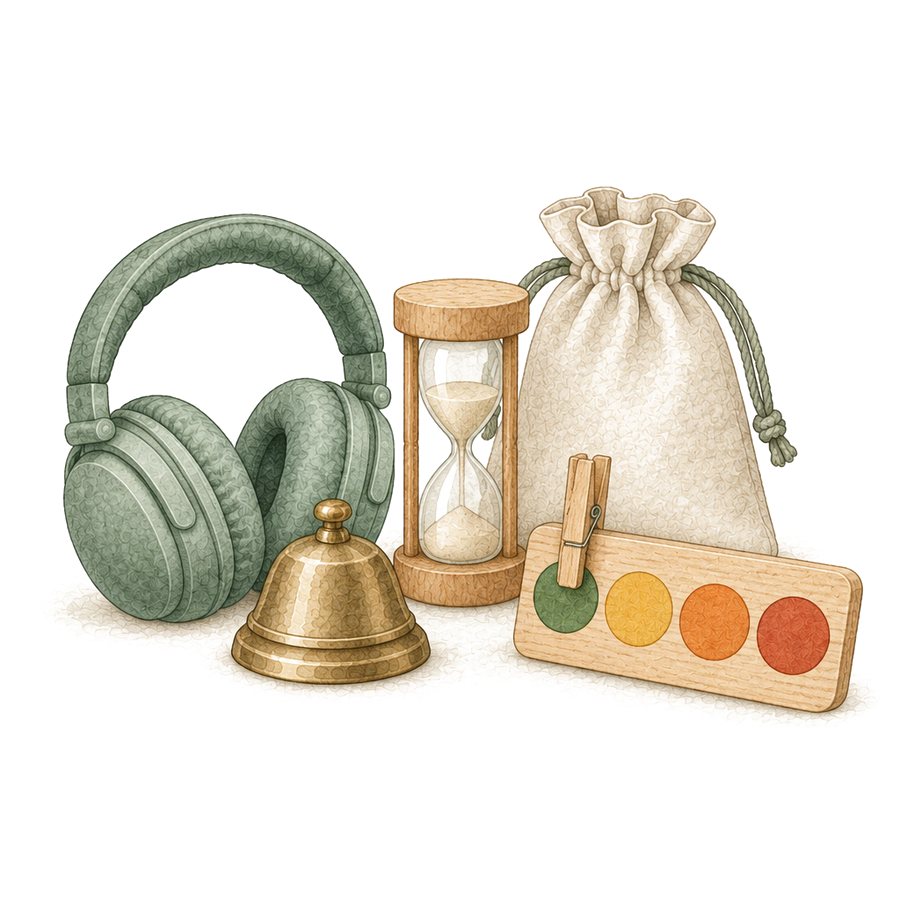
The hand signal for quiet
Raise your hand and stop talking. Anyone who sees it raises a hand too and goes quiet, so the signal ripples through the room without anyone shouting. Practice it several times in the first week, before you really need it, and it'll hold up when it counts. This isn't just for elementary school. Teenagers go along with it too, especially when they get to help come up with the signal.
Set the voice level before every work period
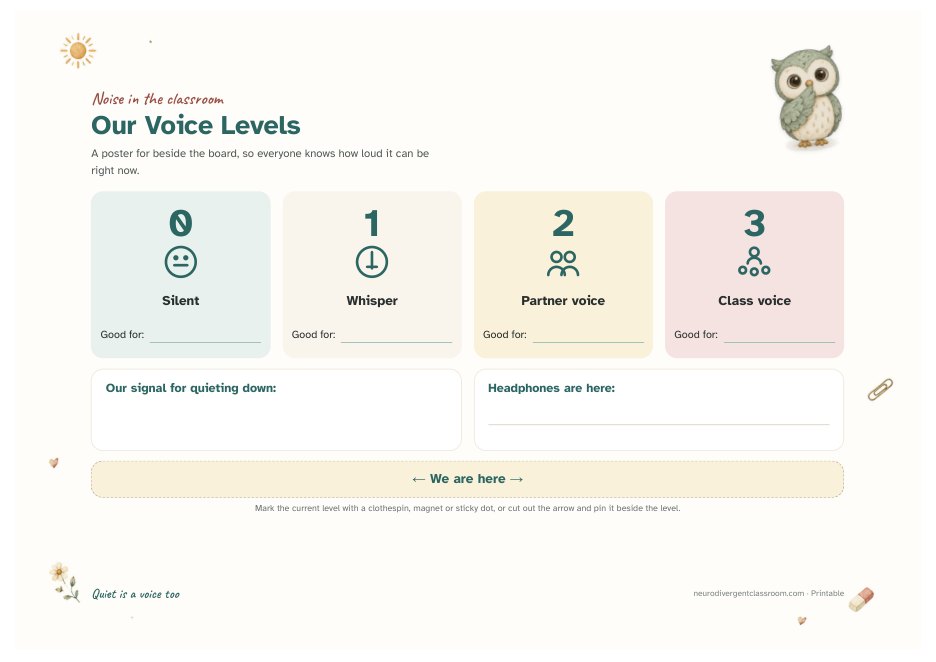
Before you start, show which volume fits right now: silent, whisper, partner voice or class voice. That way everyone knows the expectation before it gets loud, and you don't have to remind anyone afterward. Mark the current level with a clothespin, a magnet or a sticky dot, and every student can see at a glance what applies without you saying a word.
The silent countdown
Before a transition, hold up five fingers and fold them down one at a time. At zero, everyone's listening. The end doesn't come out of nowhere; it comes where everyone can see it, which helps every student who finds transitions hard.
Headphones as an option for everyone
Put out ear protection or headphones without music that anyone can use during independent work. Because the offer is open to everyone, nobody gets singled out. Whoever needs them can take them, and nobody has to.
Let the room help
Felt pads under chair legs stop the scraping when students stand up, and a closed door keeps the hallway out. Soft surfaces like a curtain, a rug or a fabric bulletin board soak up sound and can cut down the echo. ASHA recommends exactly these low-cost steps: rugs, curtains or blinds, and soft tips under chairs and tables. It works best when several things come together: a room with less echo, clear agreements, and quieter furniture.
Start small so it sticks
I've often seen good ideas fizzle because we try to do too much at once, and you already have plenty on your plate. So my advice is to start with just two signals, the hand signal and the voice levels. Explain both in two sentences at the start of class and practice the hand signal three times while it's still calm. Afterward, praise the whole class rather than individual students: “We got quiet in ten seconds.”
One new signal a week is plenty, and if things are still bumpy after two weeks, that's completely normal. New habits take time, for students and adults alike. Skip shrill sounds as quiet signals, because a sudden noise can be hardest on exactly the students you're trying to protect. And check whether the task matches the volume: partner work can't be silent. A loud room is often an engaged room, not a question of character.

Download: the poster “Our Voice Levels”
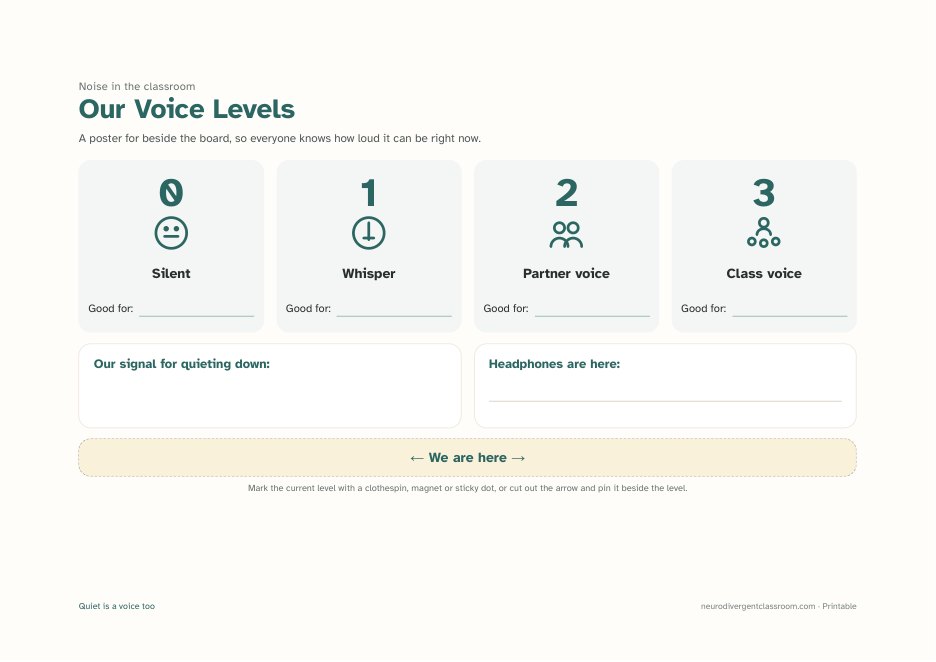
You don't have to design the voice levels yourself, because there's a ready-made poster with a watercolor frame that looks lovely next to the board. It shows four levels: 0 Silent, 1 Whisper, 2 Partner voice and 3 Class voice. Under each level is a “Good for” box that you fill in together with your class, with “test” or “group work,” for example, so the rules become your class's own. There's also room for your hand signal and for where the headphones live, plus an arrow to cut out that always points to the current level.
Every printable comes in a colorful and a simple version. Choose the one you like to work with. Click the image to open the printable.
And one just for you
A page to take a breath and write things down, no lesson planning involved.
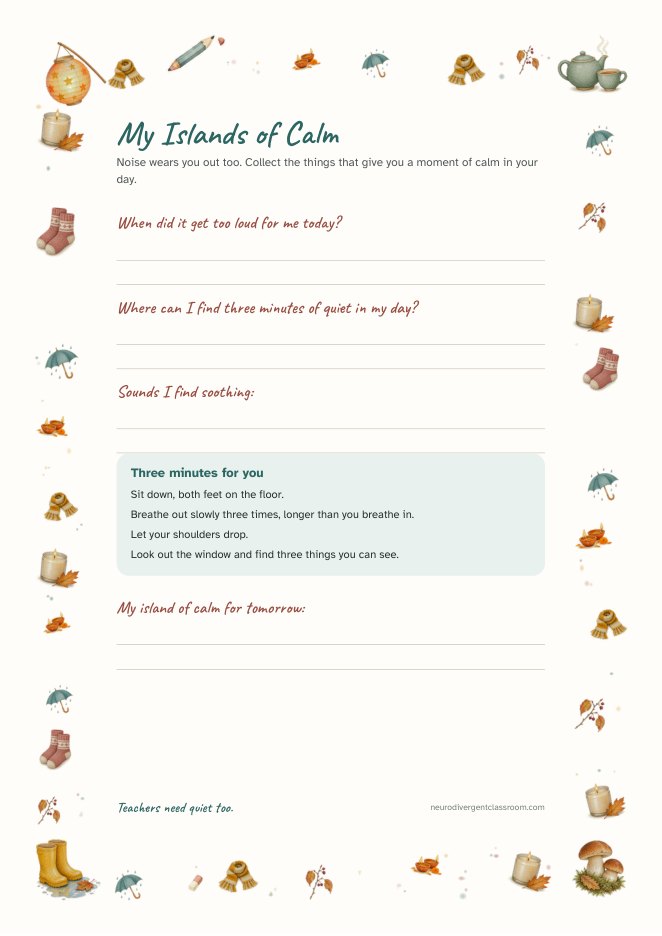
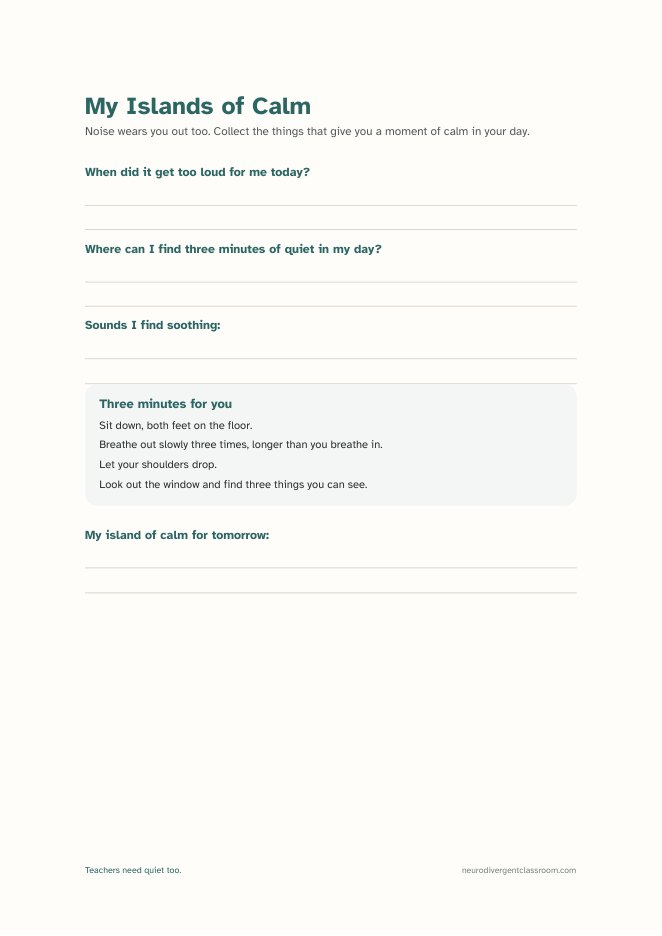
You will find these and all other printables collected in the Teacher Portal (members only).
And if tomorrow gets loud anyway, that isn't failure. It's a room full of people with something to say, and along the way you're allowed to do something kind for yourself and your voice.
Sources
- Ziegler, J. C., Pech-Georgel, C., George, F., and Lorenzi, C. (2009): Speech-perception-in-noise deficits in dyslexia. Developmental Science 12 (5), pp. 732 to 745, accessed October 18, 2026.
- Klatte, M., Bergström, K., and Lachmann, T. (2013): Does noise affect learning? A short review on noise effects on cognitive performance in children. Frontiers in Psychology, 4, 578, accessed October 17, 2026.
- National Autistic Society: Reasonable adjustments for autistic pupils’ sensory differences, published 2019, reviewed 2025, accessed October 17, 2026.
- Bavarian State Office for Health and Food Safety: Noise exposure and voice strain in schools (in German), as of August 22, 2025, accessed October 17, 2026.
- American Speech-Language-Hearing Association (ASHA): Classroom Acoustics, accessed November 14, 2026.