Blog
Recess and Break Ideas for Neurodivergent Students
The bell rings at the end of second period. Half the class bolts for the playground while a few students stay rooted to their chairs. The hallway gets loud, an argument flares up somewhere, and all you wanted was a minute to wipe the board and grab a sip of coffee.
I know those minutes all too well. Recess is supposed to be a break for you too, and yet it's often the most chaotic stretch of the morning. Maybe you're on duty in a minute, maybe a colleague is waiting to talk to you, and in your head the next lesson is already playing.
Then someone comes back from recess completely wound up, or curled so far into themselves they're barely reachable, and you can't help wondering what would have helped. Here are a few ideas that take little effort to set up and do a lot of students good.
Why one kind of break doesn't fit every student
Neurodivergent describes differences in how people perceive, think, learn and process the world around them, and those differences look different in every student. That's why a break doesn't always have to be loud, active, or spent with others.
Some students need to move so they can sit down and work well again afterward. For students with ADHD, movement, help with transitions and the right structures can be important supports at school, and shorter work periods with planned movement breaks are recommended too.
Others need the exact opposite: less noise, clear routines, or a few minutes to retreat. Unstructured free time in particular can be hard going. The noise, the crowding, the lack of clear routines and all the social demands of the playground are a real hurdle for some students, and anyone who experiences sounds, light, smells or touch differently feels all of it even more intensely. For these students, recess isn't a rest at all. It's the most exhausting part of the day.

A tip you can try tomorrow: six recess and break ideas that take little effort
-
1. Offer three different kinds of break
Offer one for movement, one for quiet, and one with a simple activity: five minutes running an errand, a quiet spot, or sorting cards. Give the options short, matter-of-fact names, so no student ever has to justify the kind of break they choose.
-
2. Make the sequence visible
Before the break, show three steps: choose, take your break, come back. Symbols, words or a small board are all you need. A clear beginning and a clear end make the transition easier, especially for students who find change or open-ended time difficult.
-
3. Plan movement that needs hardly any materials
Keep a quick job ready. A student carries books back to the shelf or wipes the board. Ten slow squats or a lap down the hallway can work too. Just sort out beforehand which route is allowed and how supervision works.
-
4. Set up a quiet option
Pick a spot with little foot traffic and few distractions. A table off to the side or the library may be all it takes. Agree on a neutral signal for coming back, such as a timer, a sand timer, or a card.
-
5. Ease the noise and the crowds
Some students do better heading into the hallway a little early, while others would rather start recess a little later. See whether a calm way out, a different seat or a quiet area is possible, and ask the student what she or he would like best.
-
6. Talk about what helps, not about behavior
Ask something like: “What makes recess easier for you?” Afterward, note only what happened, never a guess about a diagnosis. Together you can look at whether the break makes it easier to get back into learning, and the solution is allowed to change along the way.
Small stumbling blocks that are easy to miss
I've often seen good break ideas fall apart, not for lack of goodwill but because of small things. The biggest one: a break isn't a reward. If only students who behaved well get one, the student who needs it most is the one who misses out. So plan breaks as support that's open to the whole class.
Choice matters just as much. One fixed routine for everyone rarely fits, while several options almost always do. Make sure the quiet spot doesn't feel like being sent away; it can be visible and a perfectly normal part of the room. And a movement job should never sound like a punishment, so keep the wording short and neutral.
The ending is where things often go wrong. When it's unclear when and how class picks up again, coming back gets hard, and an agreed signal plus a set route back make a big difference. Finally, don't promise results. Just watch calmly whether an idea helps in your class. What works beautifully with one group may need a small tweak with the next.

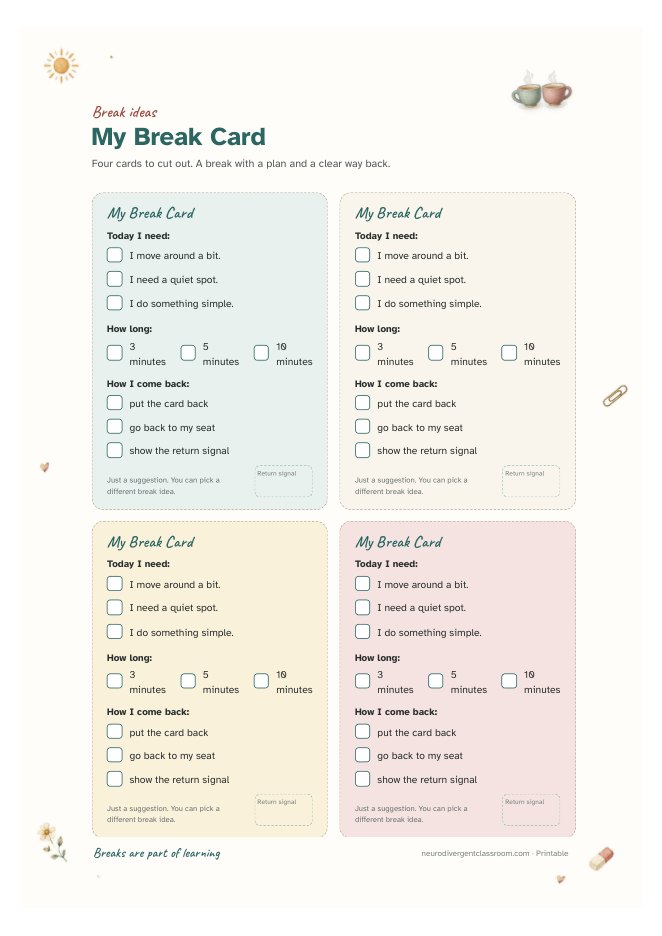
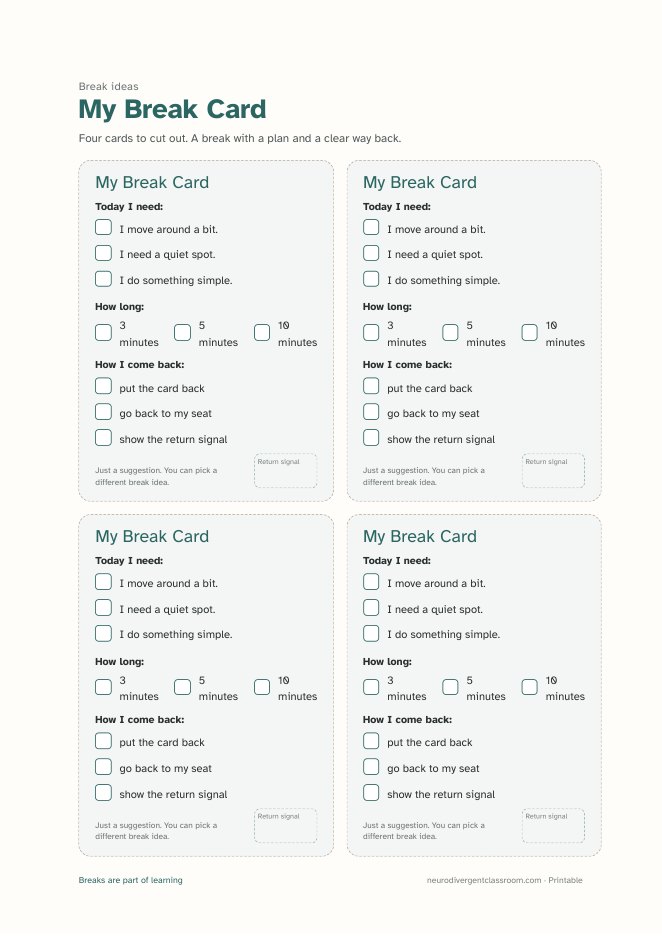
Download: “My Break Card”
With this little card, your students can show for themselves what kind of break they need right now. Under “Today I need,” they choose between “I move around a bit,” “I need a quiet spot,” and “I do something simple,” plus a length of 3, 5 or 10 minutes, and under “How I come back” they mark their way back into class. At the bottom is the friendly line “Just a suggestion. You can pick a different break idea,” with space next to it for your return signal. On the back are two questions for a quick chat after the break, and since the card has no names or personal details, you can use it again and again with the whole class.
Every printable comes in a colorful and a simple version. Choose the one you like to work with. Click the image to open the printable.
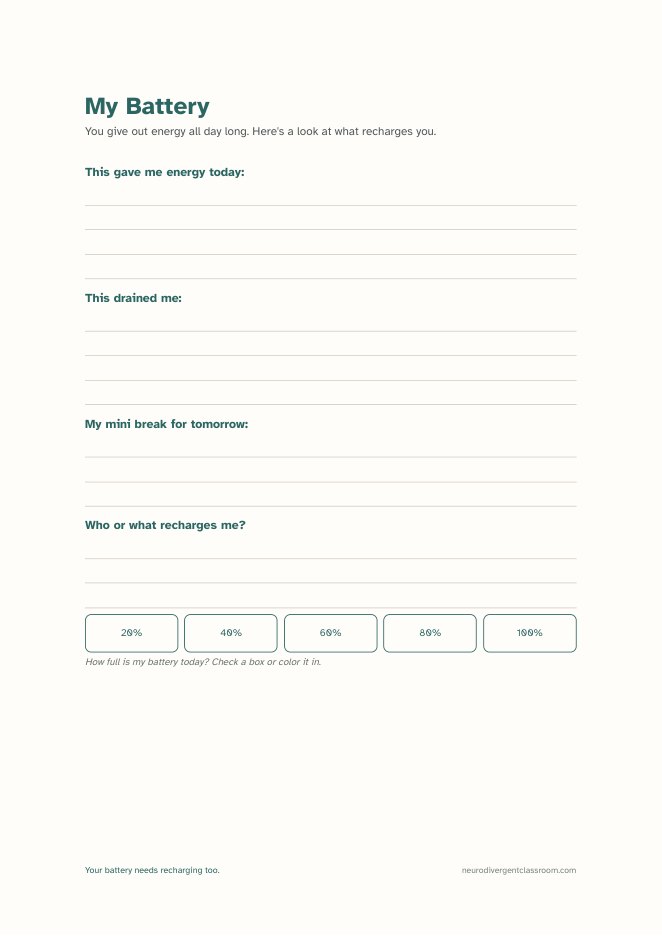
And one just for you
A page to take a breath and write things down, no lesson planning involved.
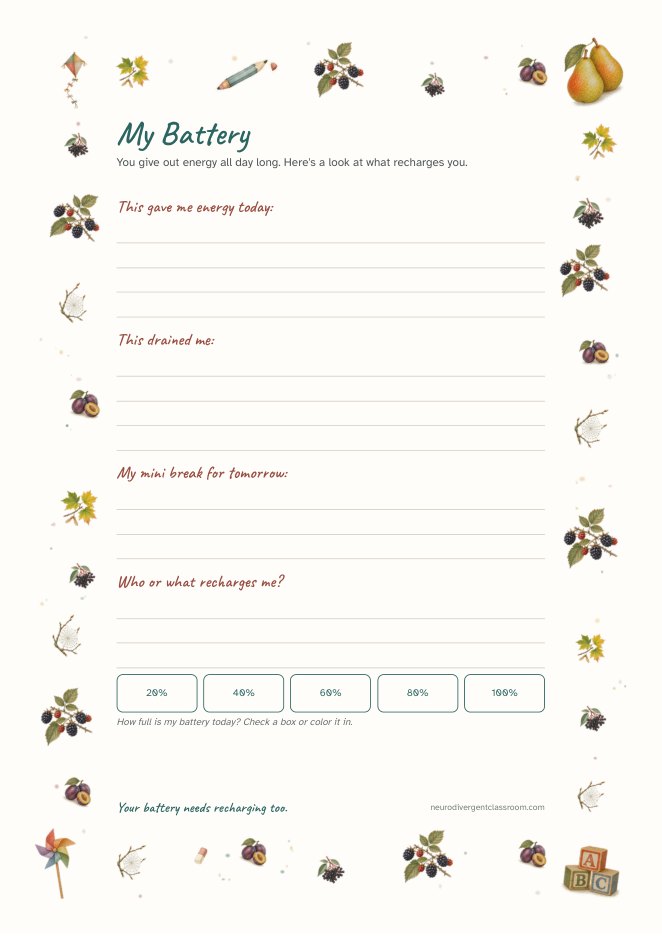
You will find these and all other printables collected in the Teacher Portal (members only).
You don't have to make recess perfect for everyone. Even a quiet corner and a clear way back can make the morning easier for some students, and maybe give you a little more breathing room too.
Related topic pages
For the background, take a look at the topic pages on ADHD, autism and sensory sensitivity.
The pages on selective mutism and auditory processing can be useful when you plan breaks, too.
The topic pages give you the background. Which break options actually work in your day is something you figure out together with your class.
Sources
- Centers for Disease Control and Prevention: School Changes, Helping Children with ADHD, accessed October 14, 2026.
- NICE: Attention deficit hyperactivity disorder, Recommendations, accessed October 14, 2026.
- National Autistic Society: Difficulties at lunch or break times, guide for teachers, accessed October 14, 2026.
- National Autistic Society: Reasonable adjustments for autistic pupils’ sensory differences, published September 9, 2019, reviewed June 6, 2025, accessed October 14, 2026.