
Blog
Parent Conferences About ADHD or Autism: How to Prepare
Parent conferences are on the calendar again. I still remember how the hard ones used to follow me around for days beforehand, the same questions going round and round: what do I say if the mother is disappointed, and what if the father sees everything completely differently?

Conference season is when everything seems to pile up at once. Maybe there's a stack of 250 tests on your desk right now. You teach so many students that not every name comes to you instantly, and yet you're expected to know exactly where each of them stands. Parents, understandably, want to hear everything you're doing. The pressure comes from every direction, and it's real.
You might have ten minutes per family. And then, right at the start, a mother asks: “Do you think he has ADHD?”
It's completely normal for conversations like this to wear you out. What helps is walking in with a clear sense of your role and a few good sentences ready. Then the conversation carries you, and you don't have to hold everything in your head.

What's part of your role in a parent conference, and what isn't
Let's start with some relief: you don't have to diagnose anything. That isn't your job at all. Whether a student has ADHD or is autistic is for doctors and other specialists to determine.
What you can offer is incredibly valuable, though. You can describe what you see in class, which is exactly what parents need, and exactly what specialists will need later on. So when someone asks you about ADHD, you can answer calmly: “That's not something I can judge. But I can tell you what I'm seeing in class.”
For everything beyond that, there's support, from the school psychologist, for example, and in some districts outside specialists will advise parents and schools if you reach out. You're not carrying this question alone. The CDC also points out that close teamwork between school, parents and health care providers helps students with ADHD.
One more thing: conversations with parents aren't an annoying extra on top of your real work. They're part of it, and they matter. When a student starts having trouble with learning, an early conversation between home and school to clear things up is often the best path for everyone.

A tip you can use at your next conference: describe, start with a strength, make one agreement
-
1. Describe instead of interpret
Say what you see, when, and how often. Instead of “He's unfocused,” try: “During 20-minute independent work periods, he usually gets up three or four times. When the task is broken into short chunks, he sticks with it longer.” Make it clear that this is how you see it, then ask how the parents experience things. When you stay factual and don't assign blame, the conversation stays much calmer. Understood.org gives teachers the same advice: share specific examples of what you've noticed and ask the family what they see at home, because they know their child best.
-
2. Start with a strength
Open with something that's going well, and be very specific: “She helps other kids clean up without anyone asking her to.” One honest, precise sentence lands far better than general praise, because what parents hear is: here's someone who really sees my daughter or my son.
-
3. Settle on exactly one agreement
A good agreement has a shared goal, a step for each side, and a date when you'll check together whether it's helping. Write down who does what by when, and put the next meeting on the calendar right away. In ten minutes, one agreement is plenty. Better one that sticks than five that nobody remembers next week.

Well prepared, without giving up your evenings
I know how tight time gets before conferences, which is why I like preparation that happens on the side. Starting about two weeks out, jot down a few words on three to five days: what was the situation, what happened, what helped? It takes a minute each time, and by the end you have something solid to rely on.
In the invitation, say what the conference is about and how long it will take, so parents can prepare too and nobody feels ambushed. When you sit down together, ask about their concerns first. They know their daughter or son from so many situations you'll never see. And skip the jargon not everyone understands. The teacher tip sheets from the Harvard Family Research Project recommend the same thing: tell families in the invitation when the conference is and what it's about, and start with the positive.
If parents ask about accommodations, you don't need to have every answer. How that works depends on where you teach: in the US, accommodations are often written into an IEP or 504 plan, in England into an EHC plan or SEN support, and elsewhere they follow your school's or education authority's policy. So it's fine to say: “That's a good question. Let me take it back and we'll work it out together with the principal.”
Sentences that carry you through the conversation
Sometimes the words desert you right at the moment that matters, and that's when sentences you've prepared ahead of time come in handy. “I'd like to share what I'm seeing in class.” “How are things going at home?” “What has worked for you?” And to wrap up: “What can we agree on until we talk again?”
A few things are better left out. Keep guesses about diagnoses out of your notes. Don't run through every difficulty of the semester; pick the one that matters most. Don't compare the student with classmates. And keep your notes confidential rather than lying out on your desk.

Download: Parent Conference Notes
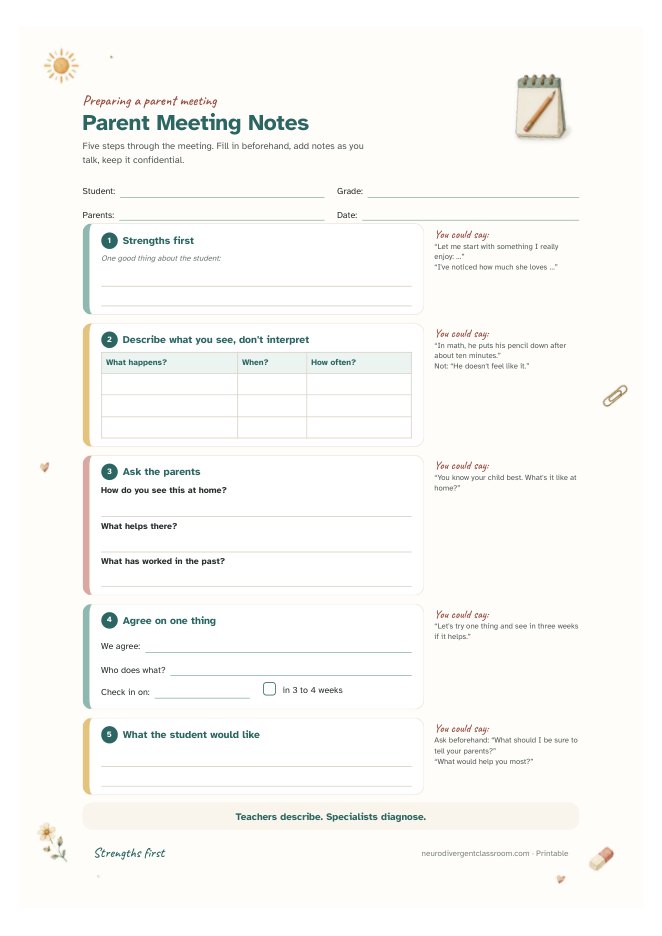
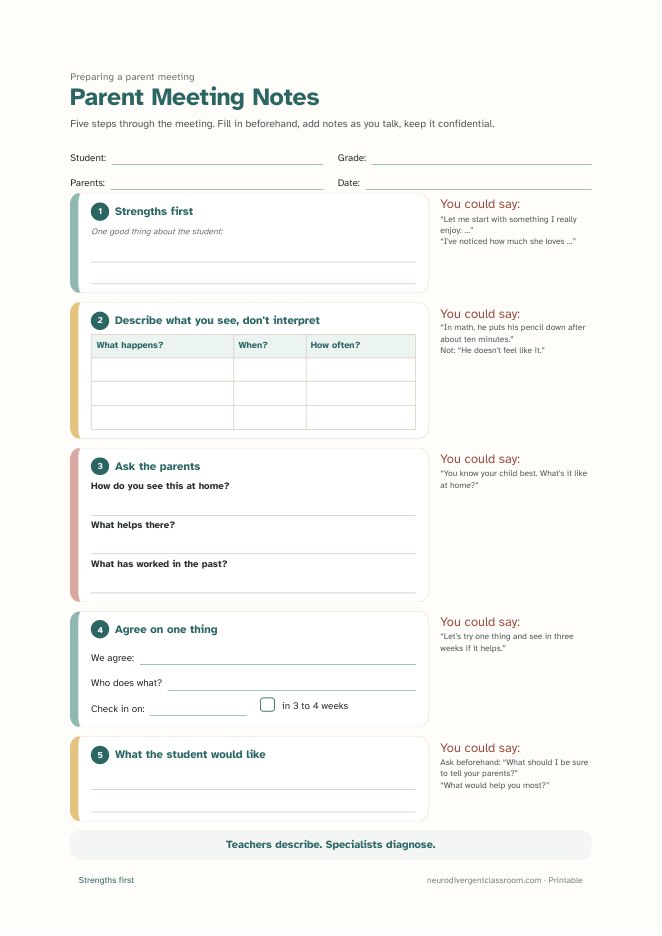
These two pages do a lot of the thinking for you, especially when you have conferences lined up back to back. At the top you fill in the names of the student and the parents, and below that, five steps guide you through the conversation: a strength first, observations with when and how often, three questions for the parents, exactly one agreement with a follow-up in three to four weeks, and what the student would like. In the margin next to each step are sentences you can use word for word. The second page has helpful sentences for difficult moments, a ten-minute prep routine, a short list for afterward, and room for notes.
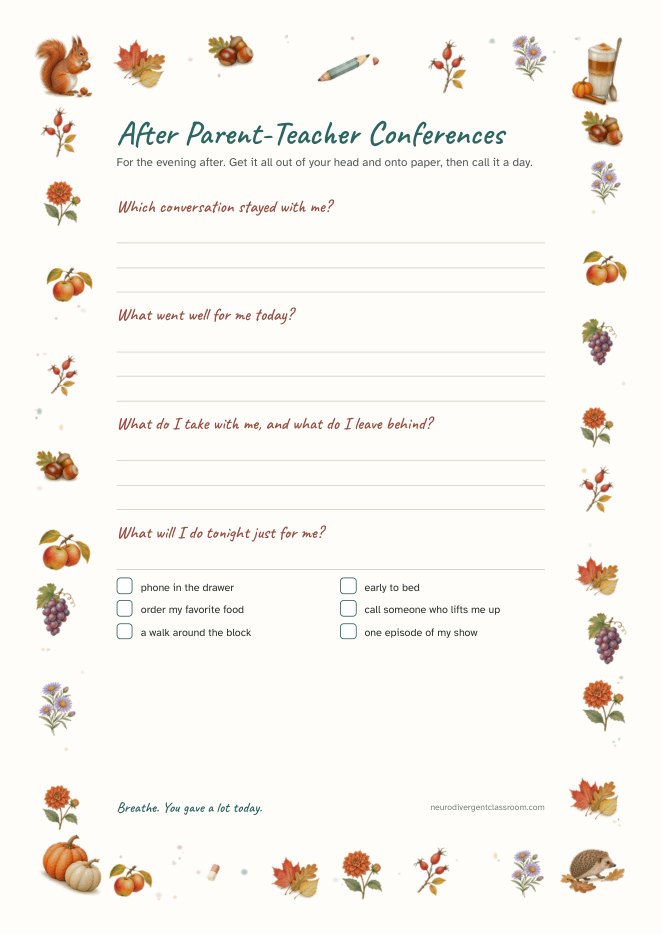
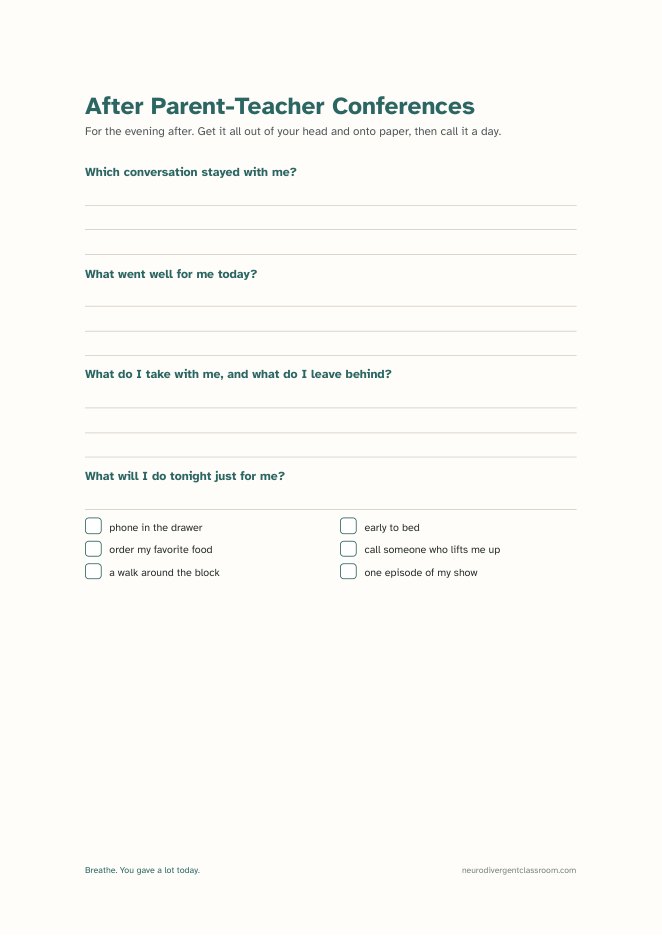
Every printable comes in a colorful and a simple version. Choose the one you like to work with. Click the image to open the printable.
And one just for you
A page to take a breath and write things down, no lesson planning involved.
You will find these and all other printables collected in the Teacher Portal (members only).
You don't have to solve everything in ten minutes. If parents leave feeling that you truly see their daughter or son, you've already accomplished a great deal.
Sources
- Harvard Family Research Project: Parent–Teacher Conference Tip Sheets for Principals, Teachers, and Parents, October 2010, tip sheet for teachers, accessed November 14, 2026.
- Morin, A.: Conversation starters for teachers to use with families, Understood.org, accessed November 14, 2026.
- CDC: ADHD in the Classroom, accessed November 14, 2026.
- Lower Saxony Ministry of Education: Teaching Students on the Autism Spectrum. Basics, Notes, Recommendations (in German), legal status April 25, 2023, sections 1 and 2.3, accessed October 17, 2026.
- North Rhine-Westphalia Ministry of Schools and Education: Working guide on granting accommodations in lower secondary school. An orientation guide for school leadership (in German), as of July 2017, sections 3, 3.1 and 4.2, accessed October 17, 2026.
- Zentrales ADHS-Netz: The guide for parent conferences (in German), undated, accessed October 17, 2026.
- Education server Mecklenburg-Vorpommern: Conversation guide for pedagogical conversation/parent conference and agreement (appendix 2 to the action guide on school absenteeism) (in German), undated, accessed October 17, 2026.