Blog
Hoods and Hats in the Classroom: Understand Before You Decide
Third row, hood up, pulled down so far you can barely make out a face. Before you've even set your bag down, you're thinking about the school dress code, about your colleagues expecting everyone on staff to hold the same line, and about the rest of the class, who are quietly watching to see what you'll do.
Of course a moment like that puts you under pressure. You're meant to keep order, teach a good lesson and keep an eye on every single student, all at the same time. It's only human if your first thought is: that hood needs to come off.
Over the years I've learned that what's going on under a hood is often not what you'd first guess. A hood can keep someone warm, shut the world out for a moment or simply make them feel safe, and a hat can take the edge off harsh light or the feeling of being stared at. Yes, in class both can look like checking out, but that doesn't mean the student isn't paying attention.

What hoods and hats can have to do with learning
Neurodivergence describes differences in how people perceive, think, learn and process the world around them. You don't have to be neurodivergent to find certain clothes bothersome, though, so it always comes down to the particular student in the particular moment.
Seams, scratchy fabrics, pressure on the skin, being too warm or too cold: any of these can quietly eat up a student's attention. Some students are especially sensitive to touch, while others pull up a hood as a kind of visual shield because it dims the flood of things to look at around them.
Sensory sensitivity means that stimuli come in especially strong or unpleasant. When too many stressful impressions pile up at once, the result can be sensory overload, often just called overload. Touch, bright light, noise, smells and crowded hallways are the kinds of things that can tip a student over. When sensory differences like these make the school day harder to get through, adjusting the clothing rules is a sensible way forward.
Why a blanket rule on hoods falls short
The same hood can do two completely different jobs. One student may be shielding herself from the room, while for another it's about regulating his body temperature. Others wear it out of habit or just because they like it. From the front of the room, there's no way to know for sure.
That's why it pays to start from the learning goal instead. Does this task really need you to see the student's face? Does she need to listen, speak or look closely at material right now? Then ask for exactly that, calmly and matter-of-factly. The hood or hat on its own isn't automatically the problem.
A tip you can try tomorrow: agreements that work in practice
-
1. Name what the task needs
Be clear about the moments when you need eye contact, listening or a clear line of sight. A general remark about clothes and behavior rarely gets you anywhere.
-
2. Offer a choice that fits
Sometimes it's enough to push the hood back a little, switch seats or swap it for a cap with a brim. A divider on the desk can help, too.
-
3. Plan ahead for tricky moments
Give students a heads-up before presentations, class photos, PE and changes in groups, so you can work out a good solution together ahead of time.
-
4. Agree on a discreet signal
When seeing or hearing really matters, a quick cue is often all it takes. Just make sure the signal never embarrasses anyone in front of the class.
-
5. Check whether it's working
Watch whether the student understands the assignment, gets started and finishes it. Sitting there calmly doesn't tell you much about that on its own.
When a student pulls back
A hood can also help someone get through a stressful stretch, and in those moments the student needs fewer words and more quiet. A shutdown is a less visible response to being heavily overwhelmed: the student barely reacts to what's going on around them anymore.
That isn't a diagnosis, and it isn't proof of autism either. What you can do in the moment is turn down the stimuli, give time and make the space feel safe. Explanations and eye contact can wait.
Talk with the student, not about the hood
A short, open question has usually gotten me further than any amount of guessing. You might ask, “What does the hood make easier for you right now?” or “What do you need so you can keep working?” Then give the student real time to answer. Some find it easier to reply with a card or by picking from a few options.
If the adjustment is something a student needs regularly, bring in your school team so you're not carrying the decision on your own. Jot the agreement down in a few lines, and after a few weeks of class sit down together and see whether it still fits.

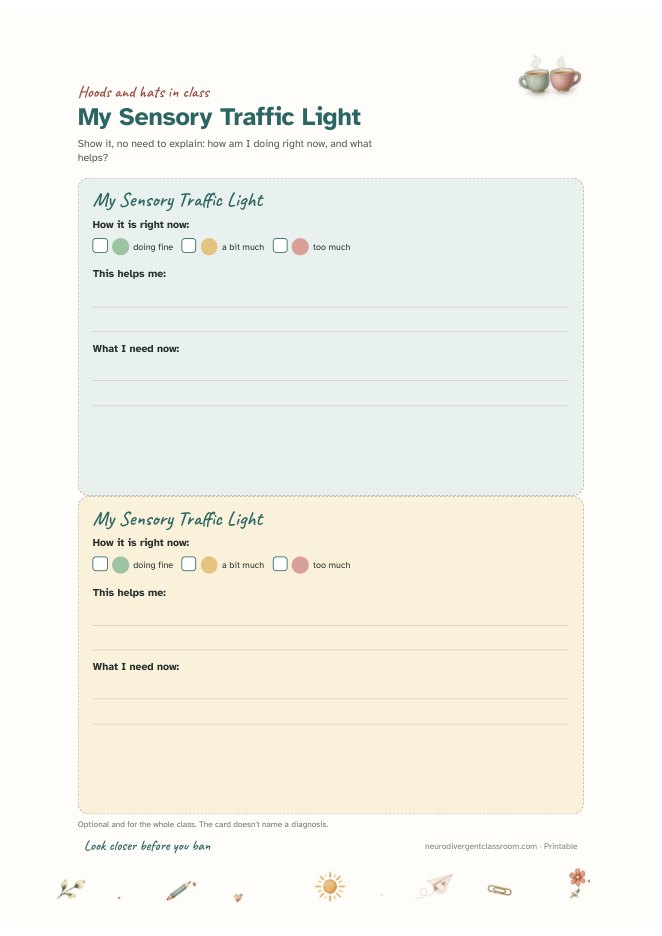
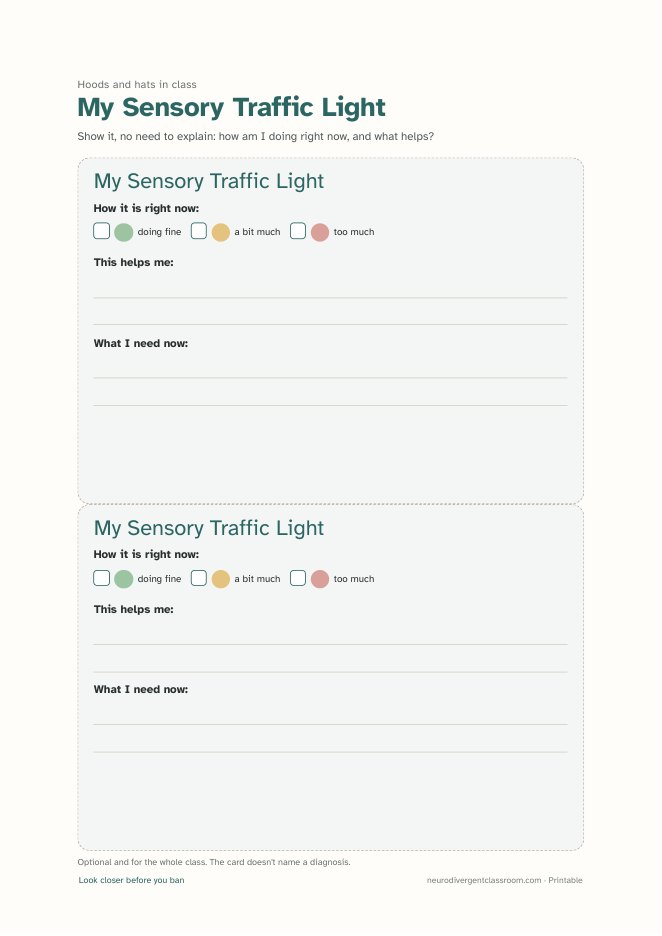
Download: “My Sensory Traffic Light”
The sensory traffic light lets students show how they're doing right now without having to find a lot of words. Three boxes guide them through it: “How it is right now,” “This helps me,” and “What I need now.” There's no diagnosis and no health information on the card, and filling it in is always optional. It works best when you offer it to the whole class: nobody stands out, and everyone gets to practice putting their own needs into words.
Every printable comes in a colorful and a simple version. Choose the one you like to work with. Click the image to open the printable.
And one just for you
A page to take a breath and write things down, no lesson planning involved.
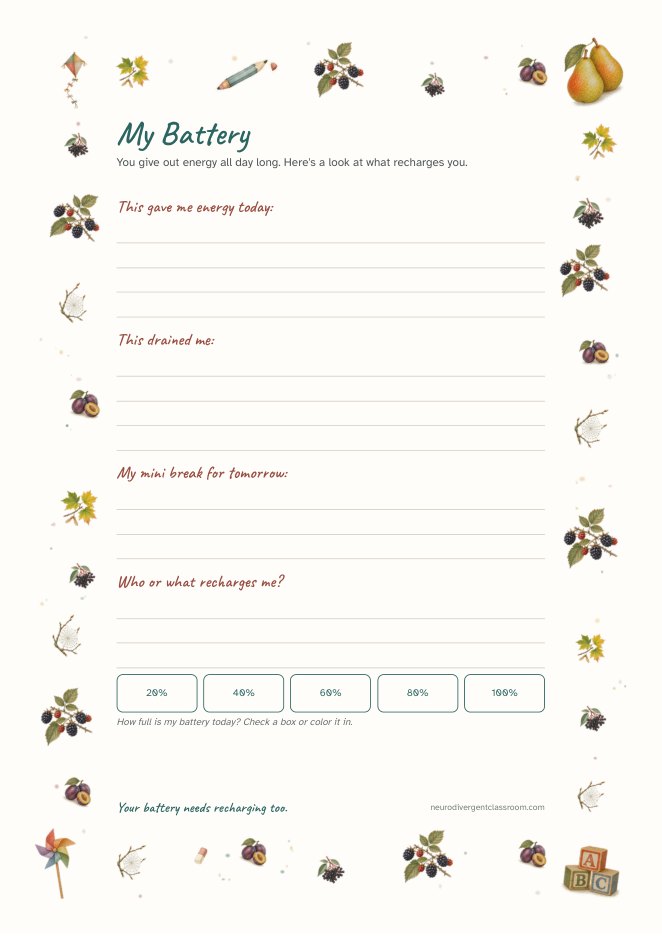
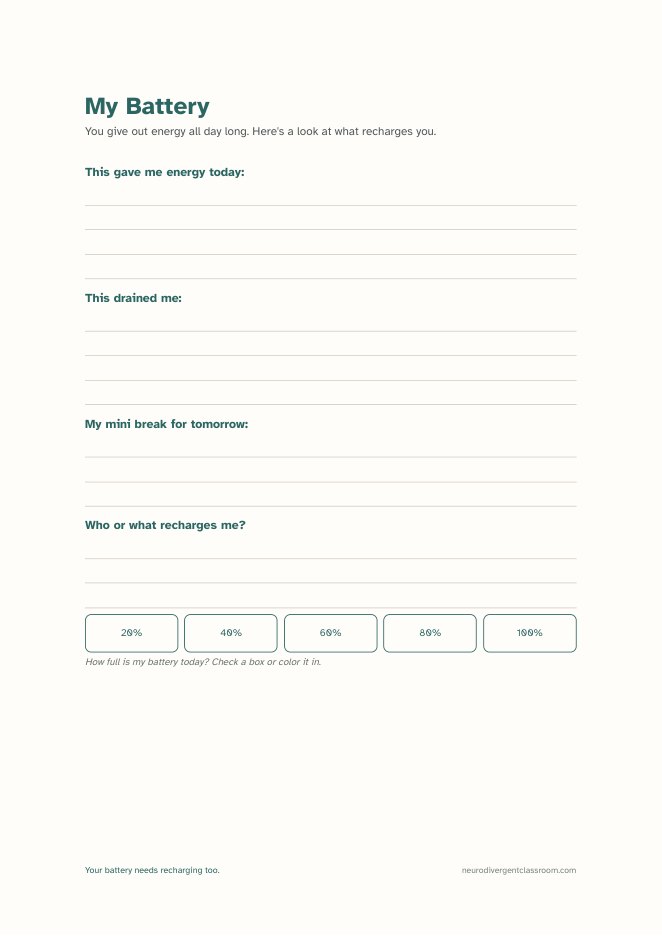
You will find these and all other printables collected in the Teacher Portal (members only).
A hood is often a solution a student has found on their own. Ask about it with curiosity before you reach for a ban, and you've already come a long way.
Sources
- National Autistic Society: Reasonable adjustments for autistic pupils’ sensory differences, published 2019, reviewed 2025, accessed October 14, 2026.
- Autistica: Supporting autistic people who are overwhelmed or having a meltdown, accessed October 14, 2026.