Blog
Honest Courage Phrases: Small Cards for Elementary Students
Read-aloud time is about to start. A student in the second row slips a small card out of her pocket and glances at it: “I can take a moment to think before I answer.” She reads it to herself, waits a beat, and a little later her hand goes up.

Nobody else noticed, which is exactly how it should be. Not every student wants to be cheered on in front of the whole class.
You know how full an elementary school morning gets. You're keeping an eye on the whole room, fielding three questions at once, remembering the note that still has to go home to parents today, and trying not to think about the support plan paperwork waiting on your desk (an IEP or 504 plan in the US, an EHC plan or SEN support in England). Of course you'd love to encourage every single student at exactly the right moment. Nobody manages that every time, and it's simply human. What helped me was handing a little of that courage over to the students themselves, in the shape of small, honest sentences.

How honest courage phrases can help
Neurodivergence describes differences in how people perceive, think, learn, and make sense of the world around them, and those differences look different in every student. A sentence that fits one student perfectly can completely miss the next.
Courage phrases start from what works, and students decide for themselves whether they use them and how. A card doesn't claim anything about who a student is. It's just a small, optional reminder for one very concrete moment.
For students with ADHD, clear instructions, positive feedback, and movement breaks can make the school day easier. Quick feedback on which strategies helped can be worth it too, especially when you teach learning strategies explicitly and then look back together at what worked.
One thing I want to be clear about, though: these little cards are no substitute for support. They don't promise any particular effect, and they won't automatically suit every student.

Why “honest” matters so much
You've probably come across sentences like “I can do every task by myself” or “I'm ready for every task.” They're well meant, but in a hard moment they rarely ring true. A student who's stuck right now feels the gap between those cheerful words and what's actually happening, and that gap can even turn up the pressure.
An honest courage phrase opens a door instead. “It's okay if I need time to think” lands very differently from “I can handle every task without help.” Every student is allowed to say that something feels hard right now, and sometimes the bravest thing a student can do is ask for help.

How to introduce courage phrases in your classroom
-
1. Start with a real moment
Watch for the moments when an honest sentence could come in handy: getting started on a task, switching between activities, or just before answering a question. Instead of a general message, write down one small next step a student can actually reach.
-
2. Leave out the exaggeration
Pick sentences that open a door. Words like “must,” “always,” or “alone” pile on pressure fast, so it's better to leave them out.
-
3. Offer more than one way in
Lay the cards out where everyone can see them, or share them digitally. Students can read them, pick one, or write their own. Some like saying their sentence out loud, while others read it silently or just look at the little picture symbol.
-
4. Pair each sentence with an action
A sentence comes alive when something concrete can follow it. “I can ask someone to explain” needs a help signal you've agreed on together, and “I can take a moment to think” goes nicely with ten seconds of wait time. That's what keeps the cards useful in the middle of a real lesson.
-
5. Keep the cards optional
Don't ask anyone to read their card to the class, and don't ask for the personal reasons behind a choice. When you introduce the cards as material for the whole class, nobody has to explain their own needs.
-
6. Check in together on what fits
After a week, ask your class, “Which sentence helped you?” and “What would you put differently?” Any card can be set aside, reworded, or swapped for a sentence a student came up with.
A few things to keep in mind
No student should have to explain to the class why a card helps, and there's no single right way to use one. Reading it silently counts just as much as drawing, saying it out loud, or leaving the card right where it is.
The cards aren't points, either, and they're not proof of good behavior. The moment they turn into a reward, they lose their lightness.
Sometimes a card on its own won't be enough. I've often seen a small change in the room make all the difference: a different task, more time, less noise, or a different seat. Courage phrases can go alongside changes like these, but they never replace them.

Download: “Honest Courage Phrases”
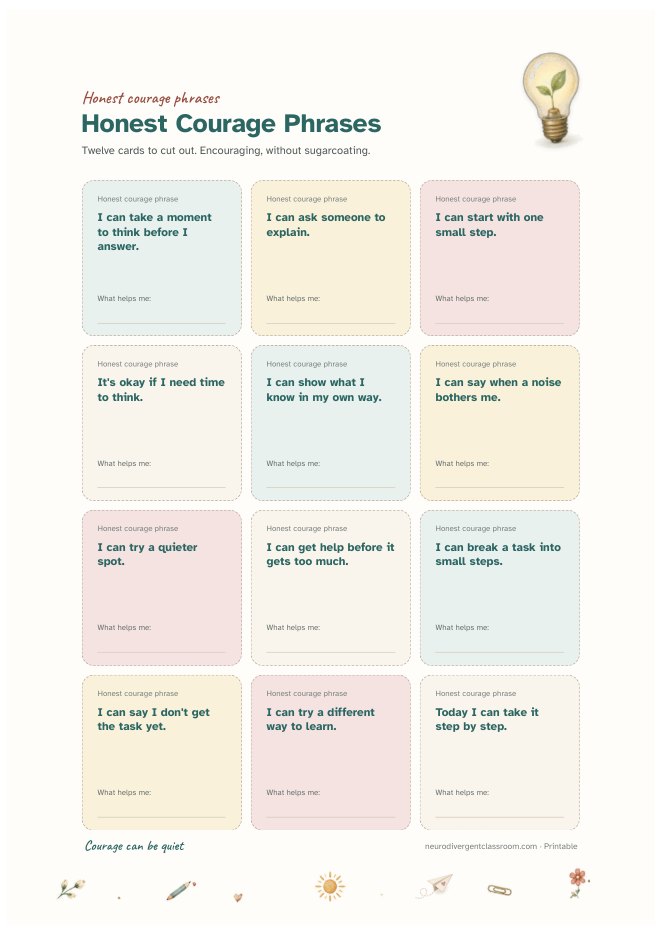
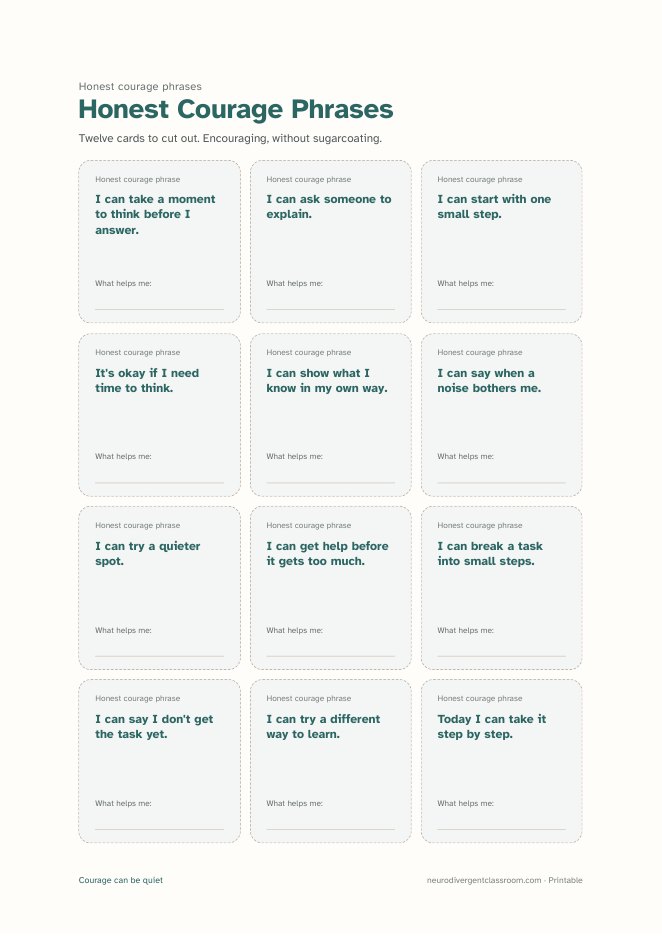
The printable has twelve cards with honest courage phrases, from “I can take a moment to think before I answer.” to “Today I can take it step by step.” Under each sentence there's room for “What helps me:”, so every student can link the sentence to a small idea of their own. On the back, students find three options to choose from: “I read it,” “I think about it,” and “Not this one today.” A line at the very bottom reminds them that each card is only a suggestion and that the student decides. Ideally, lay the cards out as material for the whole class, so no one has to explain why she or he is picking one up right now.
Every printable comes in a colorful and a simple version. Choose the one you like to work with. Click the image to open the printable.
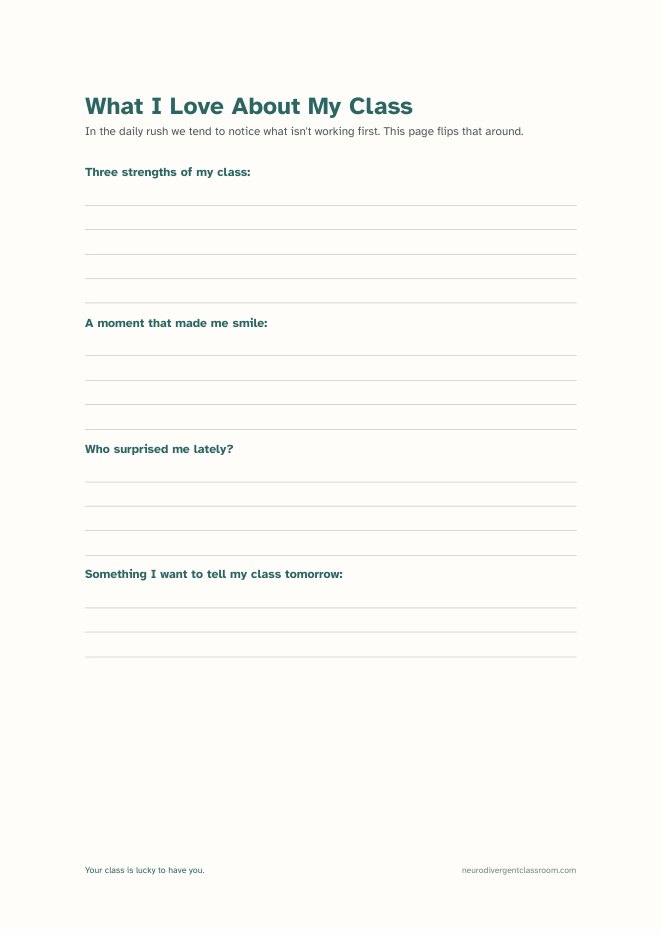
And one just for you
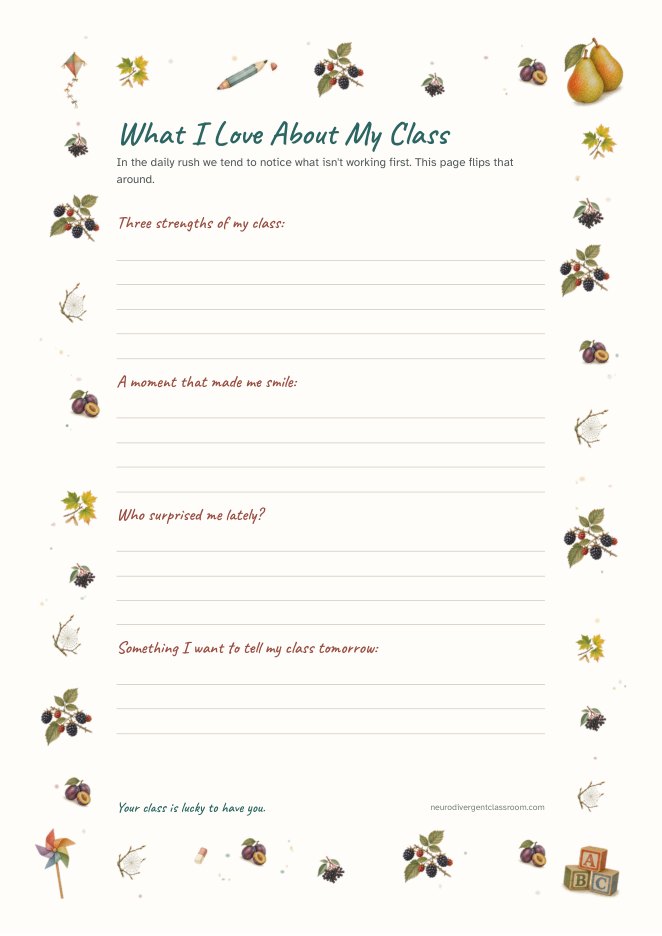
A page to take a breath and write things down, no lesson planning involved.
You will find these and all other printables collected in the Teacher Portal (members only).
Courage doesn't have to be loud. Sometimes it lives in a sentence on a small card, and sometimes it's in you, when you say honestly: this is hard right now, and we'll take the next small step anyway.
Topic pages to explore next
If you'd like to understand why this kind of support might fit, the topic pages go deeper. Start with the background on ADHD, autism, and sensory sensitivity. Auditory processing, selective mutism, and dyslexia may offer useful starting points too.
Take only what fits your class and the situation in front of you.
Sources
- National Autistic Society: Autism and neurodiversity, accessed October 14, 2026.
- Centers for Disease Control and Prevention: ADHD in the Classroom, accessed October 14, 2026.
- Education Endowment Foundation: Metacognition and Self-Regulated Learning, accessed October 14, 2026.
- CAST: UDL Guidelines, Engagement, accessed October 14, 2026.