Blog
Homework Step Cards: Small Steps Students Can Follow at Home
The homework is on the board. You've read it aloud, maybe twice. The bell rings, chairs scrape, and a student stops at your desk: “What do I have to do first?”

It's hard not to sigh a little. The lesson was packed, the next class is already crowding the doorway, and that stack of notebooks on your desk isn't getting any shorter. Walking each student through each assignment one more time just isn't something you have the energy for right now.
What's usually behind that question, though, isn't a student who wasn't listening. In class, the whole group holds the assignment together, and everyone carries a little piece of it. At the kitchen table that evening, there's no group, just an open notebook, an assignment floating around somewhere in the student's head, and no obvious place to begin. I've watched this happen more times than I can count.
Step cards are made for exactly that gap. They put on paper the order you sorted out in your head long ago, and they quietly head off a good share of the questions that would otherwise end up on your desk.

Why a clear order can be such a relief
Neurodivergence describes differences in how people perceive, think, learn, and process the world around them, and those differences look different in every student. Some find it hard to plan a task, keep their materials together, or remember what comes next. A clear order shrinks a big demand down to something they can actually handle.
Organizational supports target exactly these things: planning time, keeping materials in order, and remembering assignments. Many students find it easier to get going with a checklist or a small step-by-step aid, and visual schedules can make transitions easier to follow. The only thing that really matters is whether they fit the student and the task.
Let's be honest, though: step cards aren't a miracle cure. They won't replace a real conversation with a student, and they don't promise any particular result. Think of them as something to try out, tweak, and put away again if they don't help.

How to build a step sequence that holds up
-
1. Start with a finish line students can see
Before anything else, write down how a student will know the homework is done. For example: “The five math problems are completed and checked off in the homework planner.” Once the finish line is clear, the road there gets a lot easier.
-
2. Break the assignment into small steps
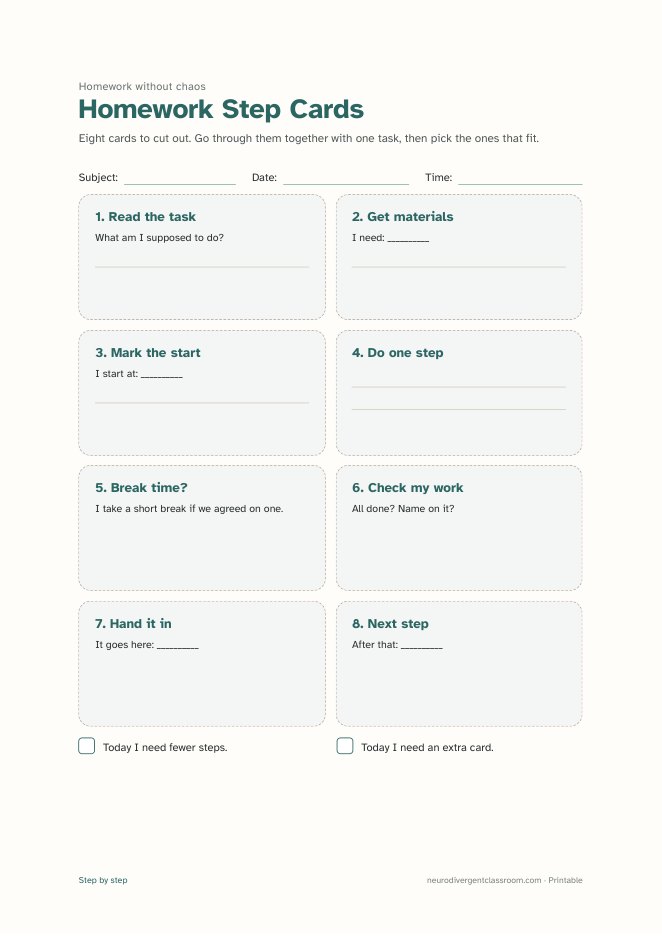
Three to five cards are usually plenty for a short assignment, and the printable gives you eight so you can pick and choose. A sequence might look like this: “Read the assignment,” “Get materials,” “Work on it,” “Check,” “Pack up.” Give every card a verb and a concrete result, and nobody has to guess what “doing it” means.
-
3. Put the assignment before the materials
The first card reminds students what the assignment is actually about, and the second lists only the materials they'll need. That way you don't end up with three notebooks spread open before anyone has figured out the task.
-
4. Show one card at a time
Lay the cards out left to right or top to bottom. When a step is finished, the student flips the card over or moves it into a Done box. For longer assignments, keep only the current step in view, so nobody has to stare at the whole mountain at once.
-
5. Build in a quick check routine
Give the check its own card with three questions: “Did I do all the parts?” “Is my name on it?” “Where do I put it?” For tests or anything with special requirements, add the routine that goes with your subject.
-
6. Make the ending and the next step clear
The last card says where the work goes and what happens next, for example: “Put the notebook in the blue folder. Then pack your bag.” A clear ending keeps the assignment from being left on the table, almost but not quite finished.
-
7. Try the cards out with the class
Walk through the sequence together using one shared example assignment, then ask: “Which card makes the next step clearer?” Change just one card at a time, and afterward check whether the assignment really got easier.
Where it sometimes gets stuck and what helps then
When a sequence doesn't work, I try to read that as a clue rather than a failure. Most of the time the problem is a card that doesn't fit yet, not the student.
Sometimes there are simply too many cards, and steps that always happen together can be merged into one. Sometimes the verbs are too fuzzy: “Do homework” tells a student very little, while something they can picture themselves doing, like “copy the three sentences,” tells them a lot. One sequence rarely fits everybody, either, so let students add or drop cards depending on the assignment.
Keep an eye on the cards so they don't slide into a way of keeping tabs on students. They're there to guide, not to grade. Without a clear transition, a lot of work ends up half done, which is why the place to hand it in and the next step always belong on the cards. If the cards feel too cute, plain words and a calm, simple layout go a long way. And when a card just doesn't work for someone, ask what's getting in the way instead of putting a label on the student.
Introduce them as a class so it doesn't eat up your time
Your time is tight, I know. Between grading, meetings, and parent conferences, there's barely room to draw up an individual plan for every student, and the good news is you don't need to.
Introduce the sequence to the whole class with one shared assignment, then let students choose the cards that fit their own work. You end up with a routine that helps everyone and singles no one out. The cards carry no names, no diagnoses, no health information, and no grades, so a student who needs more structure can simply take more cards without explaining a thing to anybody.
Over time, many students need fewer cards because the sequence has settled into their heads. On the days when everything feels harder, the cards are still there waiting.
Matching topic pages in the Teacher Portal
If you'd like to dig into why this kind of support might fit a particular student, the topic pages are a good next stop. The page on ADHD has notes on organization and on setting up work assignments, and the page on autism looks at routines, transitions, and predictability.
When sensory overload is part of the picture, head to the page on sensory sensitivity. For auditory processing, there are notes on auditory processing disorder (APD). And for math homework, the pages on dyscalculia and dyspraxia and DCD fill in more of the picture.

Download: “Step Cards for Homework”
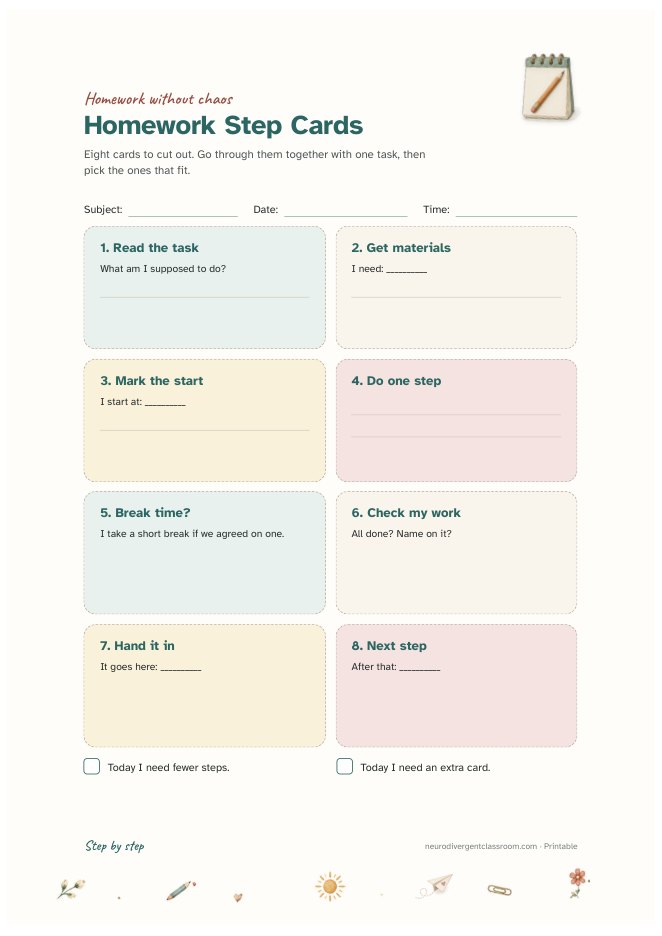
This printable walks a student through a homework assignment from the first read to packing up. Eight numbered cut-out cards lead through the task one step at a time, and each one has space for whatever today's assignment needs: the materials, where to start, or where the finished work goes. Two small boxes let a student get by with fewer steps one day or add an extra card on another, and on the back a big Done box makes the finish line visible. It works best if you walk through the sequence together with a shared assignment first and then let students pick the cards that suit them.
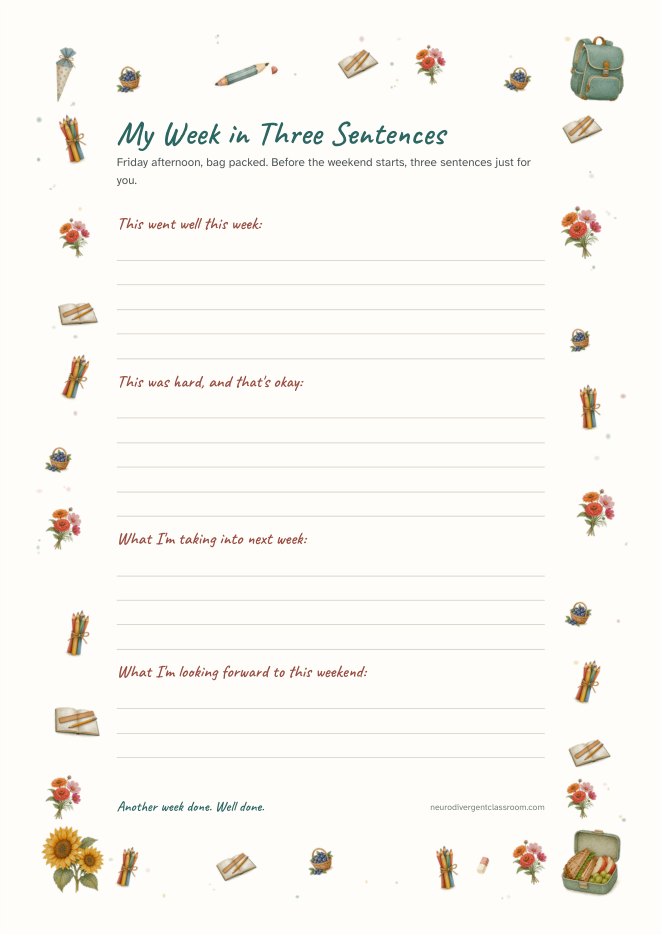
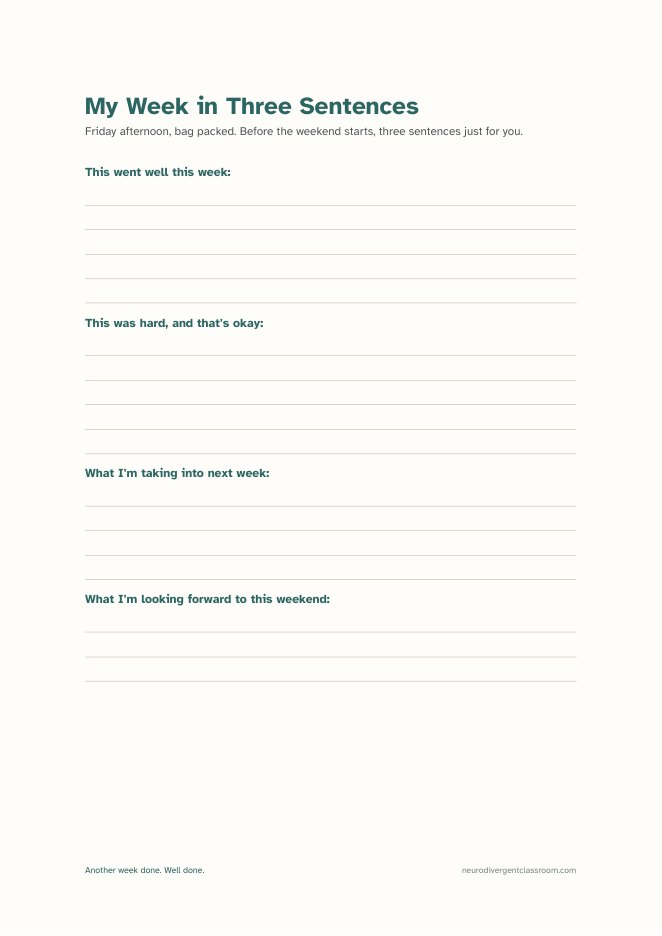
Every printable comes in a colorful and a simple version. Choose the one you like to work with. Click the image to open the printable.
And one just for you
A page to take a breath and write things down, no lesson planning involved.
You will find these and all other printables collected in the Teacher Portal (members only).
You don't have to set up every homework assignment perfectly. If a student sits down at home and knows where to start, that's already a big step.
Sources
- Centers for Disease Control and Prevention: ADHD in the Classroom, organizational aids and homework folders, accessed October 14, 2026.
- NICE: Attention deficit hyperactivity disorder, Recommendations, written instructions and adjustments in educational settings, accessed October 14, 2026.
- CAST: UDL Guidelines, Organize information and resources, graphic organizers, checklists, and organizational aids, accessed October 14, 2026.
- National Autistic Society: How personalised plans can support students waiting for a diagnosis at school, visual plans and adapting to individual needs, published June 27, 2025, accessed October 14, 2026.