Blog
Halloween Without Sensory Overload: A Party for the Whole Class
Somewhere around the last week of October, the air in the classroom starts to change. The costume talk has been going on for days, cotton spider webs are creeping across the hallway, and before first period is even over, someone wants to know when the party starts. I know that buzz well, and I know just as well that the regular school week doesn't stop for it.
Maybe you're stuck right now between a pile of tests to grade and the question of when you'll ever get the party ready. Then there's the student who goes quiet at the mere mention of masks, and the one who jumps every time a door slams. You want the day to be good for all of them, and that's a lot to carry.
Here's the good news: you don't have to cancel Halloween to make it work for everyone. It takes a little thoughtfulness, not sacrifice. The spooky fun stays; it just gets some structure around it.
This year Halloween falls on a Saturday, so plenty of classes will celebrate on Friday, October 30, or a few days earlier.

Why Halloween can feel like too much for some students
On Halloween, nearly everything changes at once. The schedule's different, the room has been transformed, familiar faces vanish behind masks, and there are sounds, lights and smells that never show up on a normal day.
Many autistic students take in sensory input differently from their classmates. A noise that's just a bit loud to one child can genuinely hurt another or set off real fear. Not knowing what comes next is frightening in itself: What's happening now? When will this be over?
Over the years I've seen a predictable day do half the work for you. Students who know what's coming feel safer, and a sound you've been warned about is far easier to handle than one that comes out of nowhere. Students with ADHD gain from the very same things: a clear heads-up before every change and permission to take a break in between.
It pays to walk your class through the party a few days ahead of time. If it still turns out to be too much for someone, have another option ready. Sitting it out can be okay, too.
Four simple ways to make the Halloween party easier for everyone
You only need to make four decisions, and none of them means giving up the spooky fun.
-
1. Share the plan ahead of time, ideally with pictures
The day before, put five pictures up on the board: arriving, crafts, story, snack, clean-up. Mention the end, too, something like: “At 11:30 the party's over, and then we'll do some reading.” Knowing exactly when it ends often settles students more than any long explanation could.
-
2. Don't hit every sense at once
Fog is fine, and so is a flickering light, but then you don't also need loud music and a scent in the air. Scented candles are best left out altogether. Bring in one kind of sensory input at a time, and give a heads-up before the lights go out or the fog machine starts. Check with parents before you use flickering light, since some students react strongly to it, for example students with epilepsy. Epilepsy Action lists strobe lighting and flickering bulbs as possible triggers and notes that photosensitive epilepsy usually starts before the age of 20.
-
3. Make everything optional
Nobody has to dress up, and nobody has to step into the spooky room. A hat or a sticker is plenty. Students who'd like to can pick a costume from a favorite topic instead of something scary. What matters is that it feels good to them.
-
4. Open a quiet room for everyone
Set up a second room next door with just a touch of Halloween, or none at all. Put on a calm movie or lay out some games, and make sure an adult is always there. Any student can walk in without asking and without having to explain why.
Checking in and out at the quiet room door
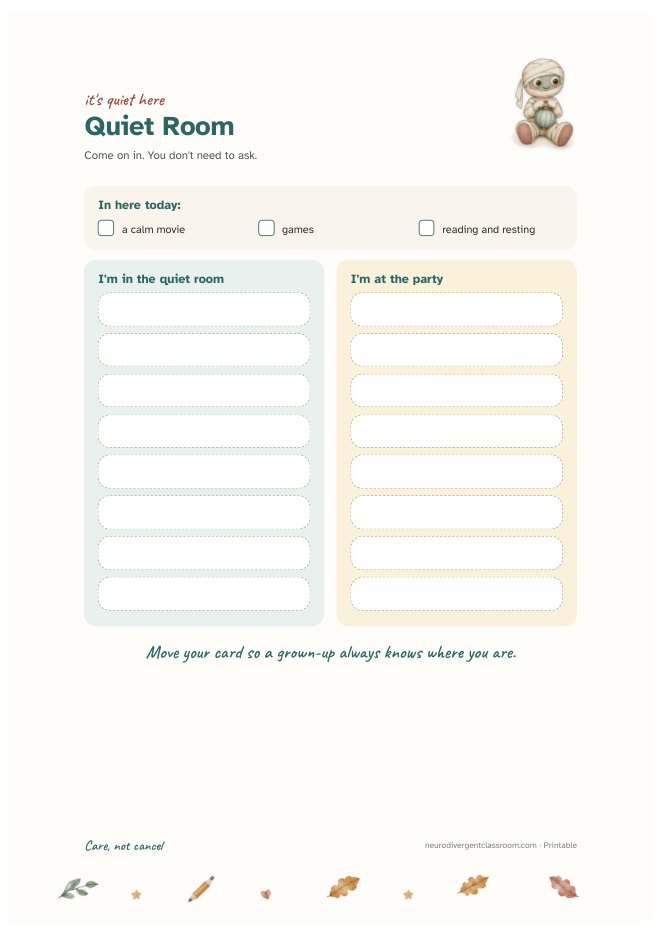
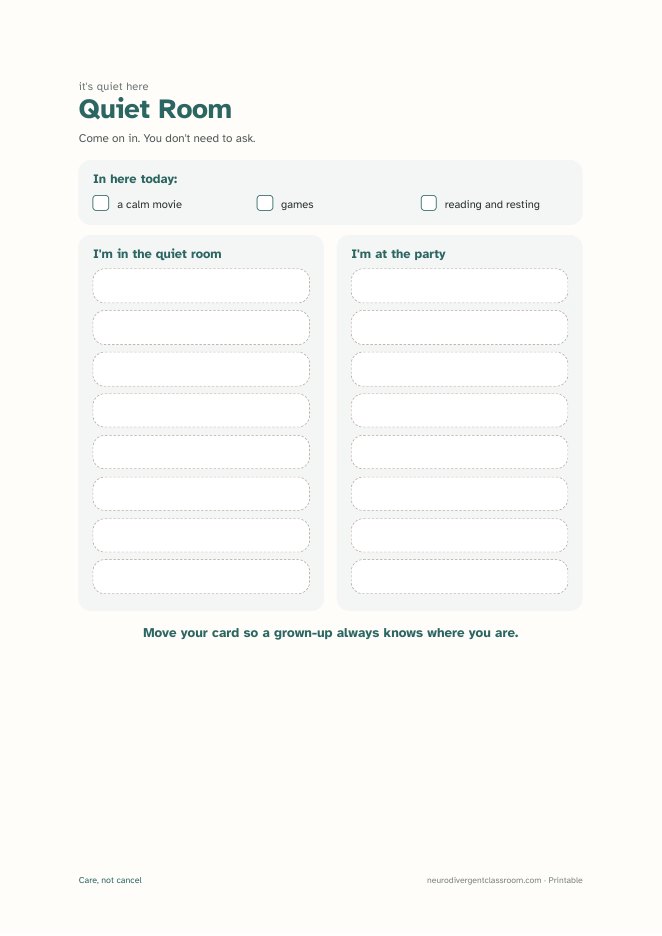
Two rooms, and you're still supposed to keep track of everyone? That's exactly what the name cards are for. A board with two sides hangs on the quiet room door: “I'm in the quiet room” and “I'm at the party.” Students hang their card on one side when they go in and move it across when they come back. Nobody has to ask or explain themselves in front of the class, and the adult on duty can see at a glance who's where.
What I love most about this setup is how ordinary it makes a trip to the quiet room. Taking a break isn't weakness, and it isn't a lack of interest. Sometimes it's exactly what a student needs to come back to the party happy a little later.
Join in, watch, or take a break: every choice counts
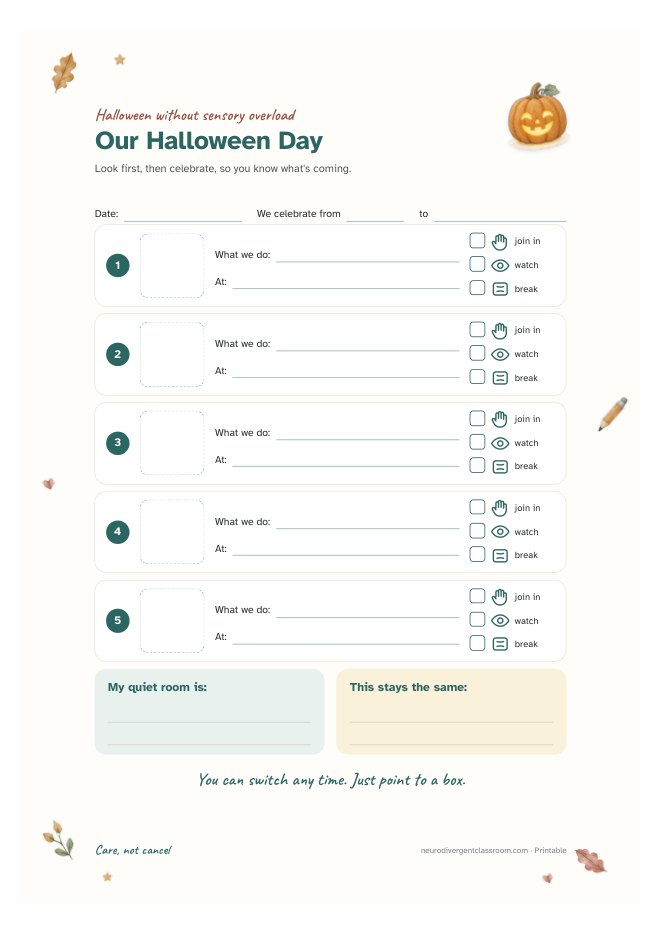
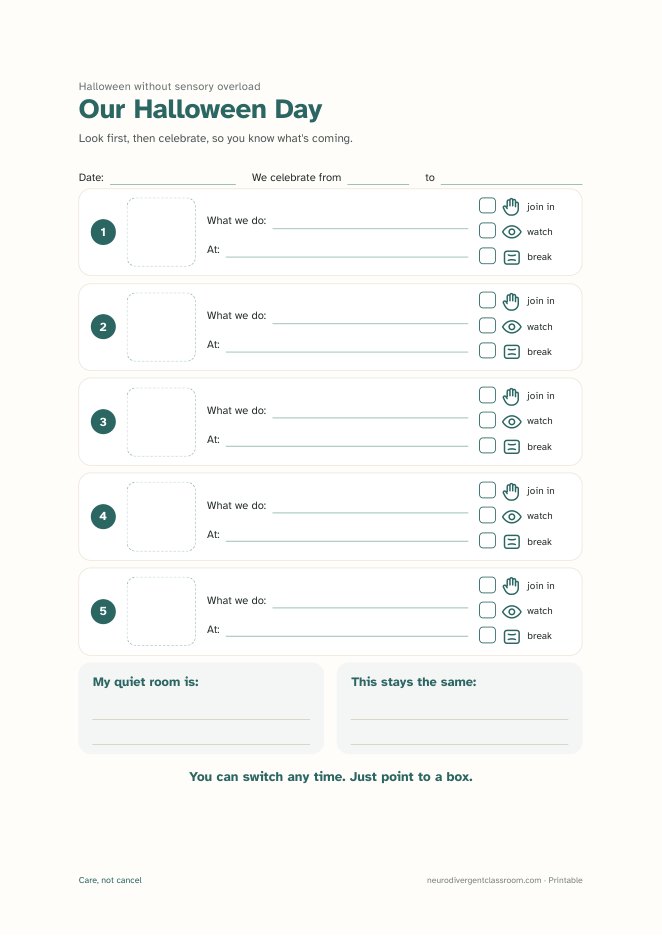
Offer three options for every activity: join in, watch, or take a break. Watching is a way of being there, too. The student decides and never has to justify the choice to the class. Anyone who doesn't feel like talking can simply point to a box on the schedule card, and switching is allowed at any time, so the child who started out in the quiet room might jump back in at snack time.
When in doubt, plan less. Three activities are plenty for a double period. Tell students what stays the same, too: recess, the bell, pickup time. And sort out snacks and allergies with parents beforehand, so you're not juggling them on the day itself.

Download: Halloween Schedule Card, “Quiet Room” Door Sign and Name Cards
The schedule card lays out the whole day for your class in five steps, each with a picture box and a time. At every step, students check whether they want to join in, watch, or take a break. In the boxes “My quiet room is” and “This stays the same,” you fill in where students can go and what they can count on. The “Quiet Room” door sign, with its two columns “I'm in the quiet room” and “I'm at the party,” goes on the door. Then cut out the name cards with their little Halloween stickers and let students write their names on them.
Every printable comes in a colorful and a simple version. Choose the one you like to work with. Click the image to open the printable.
Quiet Room Door Sign with Name Cards for Checking In and Out
And one just for you
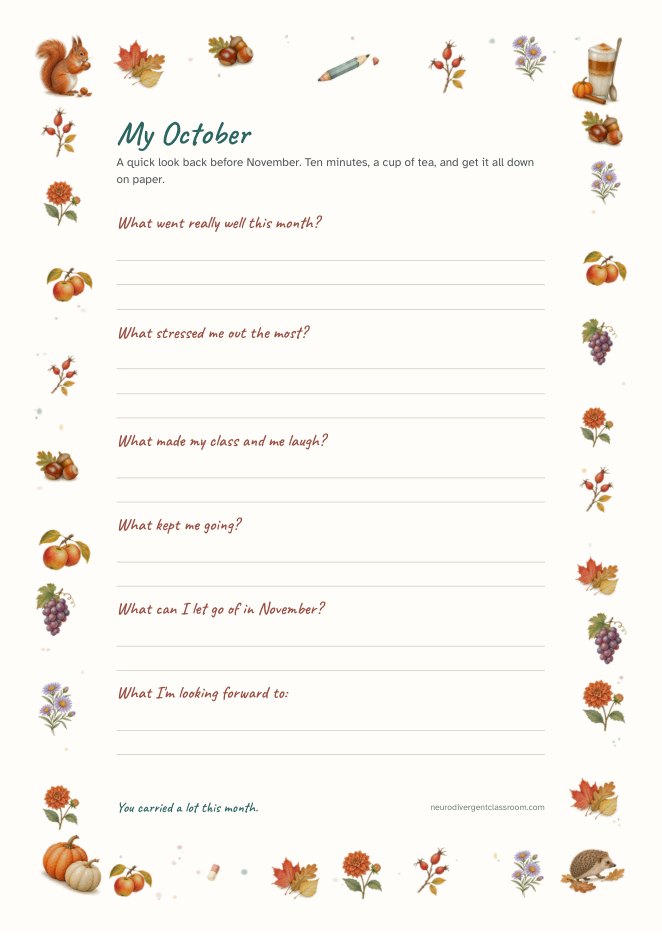
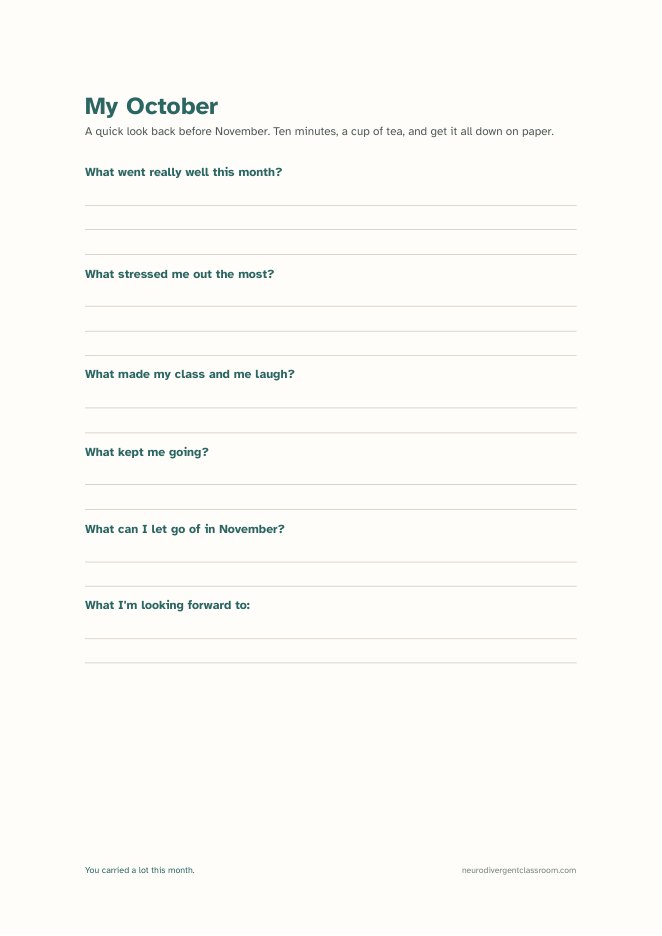
A page to take a breath and write things down, no lesson planning involved.
You will find these and all other printables collected in the Teacher Portal (members only).
The day doesn't have to be perfect. If everyone can say at the end that they were part of it, each in their own way, you've gotten a whole lot right.
Sources
- Cutting, A., National Autistic Society: Sensory differences and reasonable adjustments for autistic pupils, published September 9, 2019, reviewed June 6, 2025, accessed October 17, 2026.
- Lower Saxony Ministry of Education: Teaching Students on the Autism Spectrum. Basics, Notes, Recommendations (in German), legal status April 25, 2023, section 2.1.1, accessed October 17, 2026.
- Centers for Disease Control and Prevention: ADHD in the Classroom, as of June 1, 2026, accessed October 17, 2026.
- National Autistic Society: Halloween tips, October 29, 2021, accessed October 17, 2026.
- Epilepsy Action: Photosensitive epilepsy, accessed November 14, 2026.