
Blog
Classroom Countdown: Making the Wait Visible for Students
It's Monday, the class trip is still a long way off, and three students have already asked you: “How many more days?” They ask again on Tuesday. By Wednesday you're quietly wondering how many more times you'll answer that question before the day is out.

I know those days before a big event all too well. On top of the actual teaching, there are notes going home, permission slips to chase down and packing lists to write, and somewhere a pile of tests is probably still waiting to be graded. Then the same question lands for the tenth time, and even when you completely understand the excitement, it wears you down a little.
Nobody who asks is trying to get on your nerves. More often, the question tells you that the stretch of time before the big day is hard for some students to grasp. A countdown they can see turns that fuzzy waiting time into steps they can follow, and it answers the question for you, so you don't have to start from scratch every single time.

Why a visible sequence helps students wait
When you break a long, blurry wait into separate steps, students can see what's coming, what's happening today and what comes after that. Transitions become more predictable, and for many students, predictability is exactly what makes them feel safe.
Picture-based plans like this can be especially helpful for autistic students, above all when you practice using them together, one step at a time. To be honest, though, the research is still fairly thin, and the studies aren't all equally strong. I find that worth knowing, because it takes the pressure off: a countdown is something you offer, not a miracle cure.
Not every student will take to it, and that's fine. Watch which format really helps your class and trust what you see. Nobody knows your students better than you do.

How to build your classroom countdown
-
1. Pick an event with a clear end point
Start with something that has a fixed date, like a class trip, a school break, or a project day. Then write the occasion up where everyone can see it, for example: “Our project day starts on Friday.”
-
2. Split the wait into equal steps
Give each school day, or each night away, its own section with a date on it. Before a class trip you can also count down the nights, which some students find easier to follow than days of the week.
-
3. Show only what's next
Each morning, cross off the current section with the class or take down one card. Then ask a quick “What's on for today?” so everyone's attention stays on that one step.
-
4. Add information students can count on
Next to each date, jot down what goes with it, say, “Wednesday: check the backpack list.” Write down what isn't changing, too: “The meeting spot stays the same.” Often it's exactly those fixed points that give students something to hold on to.
-
5. Make changes visible
If the project day gets moved, don't just quietly take the old date down. Mark the change clearly, write “New: Thursday” with the new date beside it, and read it out loud together with the class.
-
6. See how it works day to day
Is the countdown hanging somewhere everyone can easily see it? Is the writing big enough? Some students will want a copy of their own, while others would rather not have it in front of them all day long, and that's okay, too.

Three examples from the classroom
Before a school break, each section stands for one school day, and on the last one you add a single line: “Today: break begins.” It sounds almost too simple, but it gives the countdown a clear, friendly ending.
For a class trip, the calendar shows the date, the number of nights and a short packing reminder, while the full packing list hangs somewhere else. That keeps the countdown easy to read, and nobody has to dig through a wall of information.
Before a project day, the countdown covers the preparation, the project day itself and the perfectly ordinary school day that follows, so the end is visible, too. For many students, that's the part that matters most: knowing what happens afterward.
Tips to keep your countdown simple
Start small. A single date and one action are often plenty. Leave out fuzzy words like “soon” or “later” and write a date instead.
Think of the countdown as information, not as a way to hurry anyone along or build up suspense. If plans might change, don't promise that they won't. It's perfectly fine to be honest about where things could still shift.
And when someone asks again anyway? What helps me is not treating the repeated question as an interruption. It's telling me that time still feels unclear to this student, and often all it takes is pointing to the calendar. One last thing: don't let the countdown stop at the event itself. Show the first step after it, too.

Download: “Tear-Off Countdown Calendar for a Class Event”
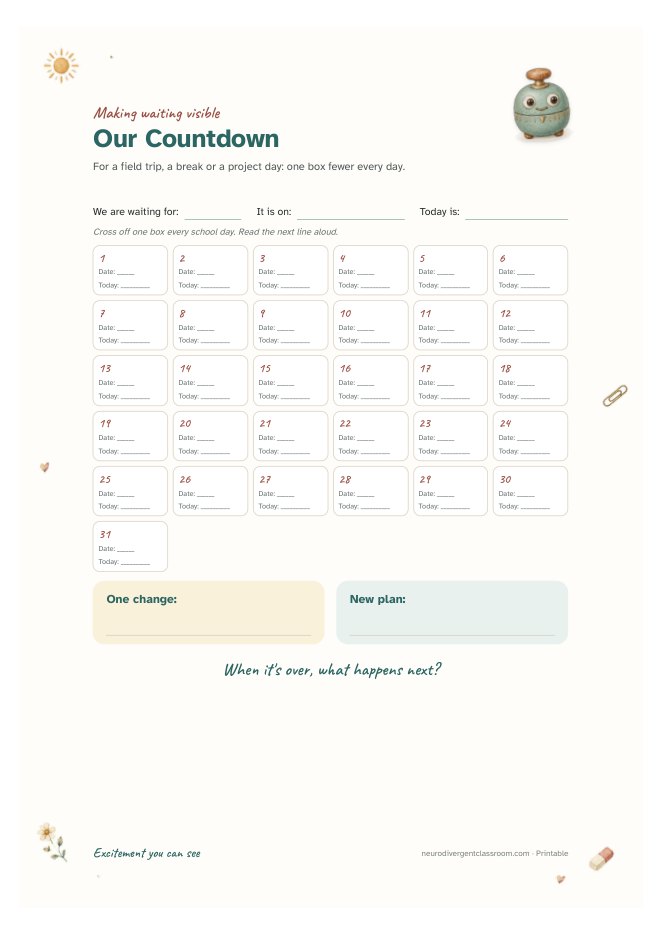
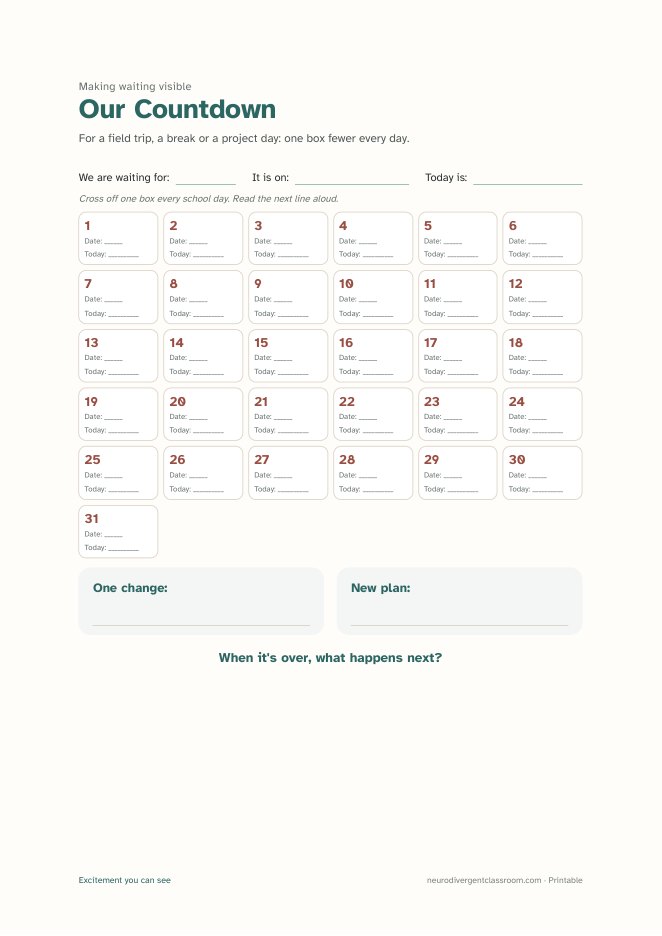
This tear-off calendar is ready to go, so you don't have to make anything yourself, and it works for a class trip, a school break, or a project day. At the top, under “Our Countdown,” you fill in what you're waiting for, when it happens and what day it is today. Below that are 31 numbered boxes where you write the date and a short action for each day, and every school day you cross one off together. If something gets moved, there are separate boxes for the change and for what applies now. At the very bottom there's a question about what comes next once the event is over, so the ending gets a good place of its own.
Every printable comes in a colorful and a simple version. Choose the one you like to work with. Click the image to open the printable.
And one just for you
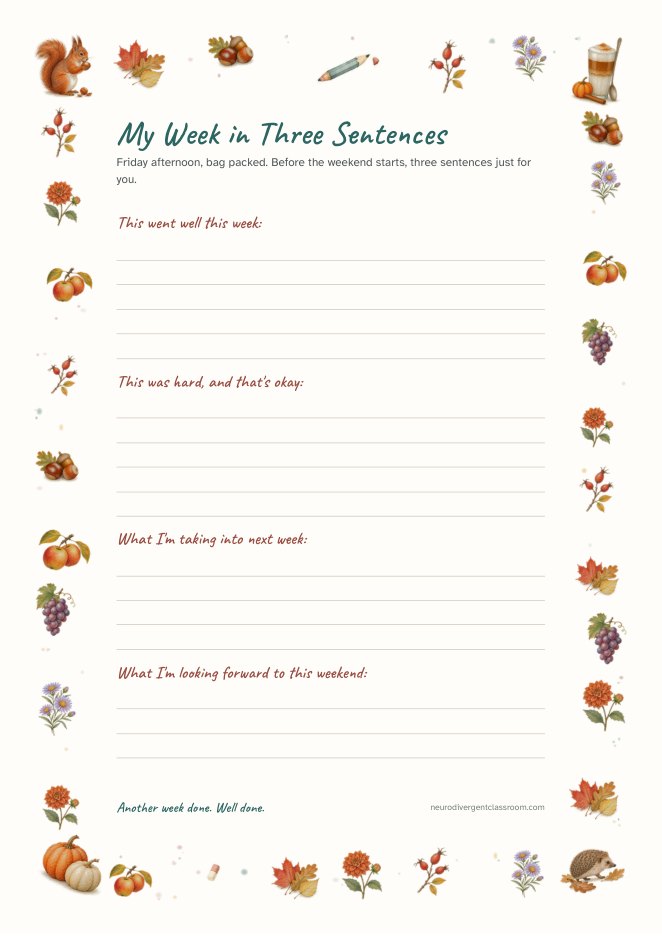
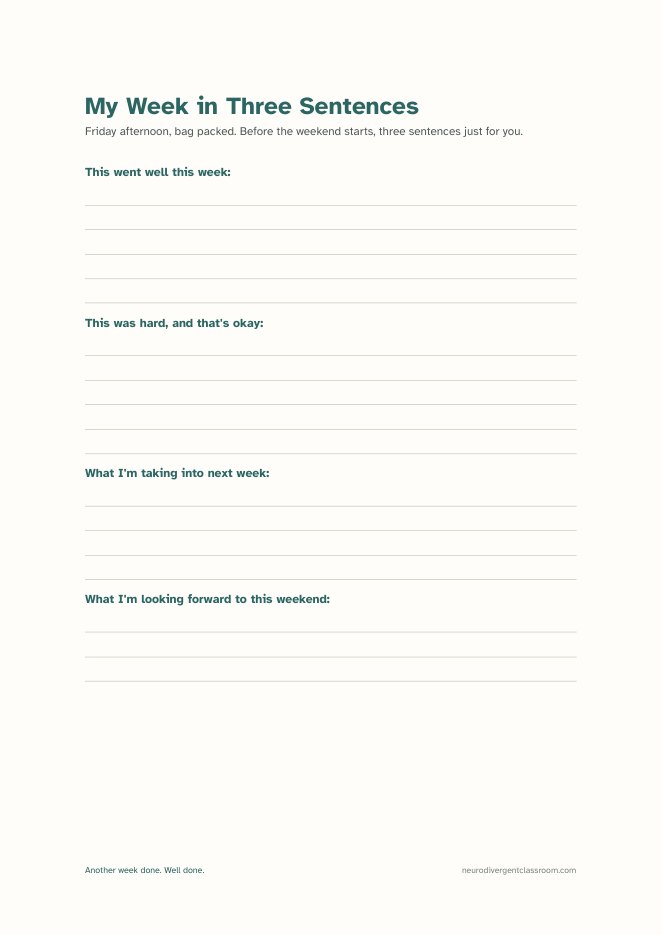
A page to take a breath and write things down, no lesson planning involved.
You will find these and all other printables collected in the Teacher Portal (members only).
“How many more days?” doesn't have to be your job, over and over, every single day. Let the calendar take it off your hands, and let yourself enjoy a little of the excitement, too.
Related topic pages
If you use the topic pages in the portal, you'll find more ideas under ADHD, autism, sensory sensitivity, and auditory processing. Pick only what fits your class and the occasion at hand.
Sources
- Knight, V., Sartini, E., and Spriggs, A. D. (2015): Evaluating visual activity schedules as evidence-based practice for individuals with autism spectrum disorders. Journal of Autism and Developmental Disorders, 45, 157 to 178, accessed October 14, 2026.