Blog
Accommodations for ADHD and Autism: What You Can Do in Class
Tomorrow's test is printed and stacked on your desk, and you're just reaching for the light switch when it comes back to you: one of your students is supposed to get extra time. How much was it again? And does that count for next week's quiz, too?

Between grading, meetings and parent emails, an agreement like that slips through the cracks so easily. I've lost track of one more than once myself. Then someone in the staff room wonders out loud whether extra time for a few students is even fair to everyone else. It's an understandable question, and it usually comes up because two different things get lumped together. Luckily, they're quite easy to tell apart.
Let's untangle it together: what an accommodation actually is, how it usually gets decided, and what you can do in your own classroom, wherever in the world you teach. One thing up front: this isn't legal advice. The rules come from your school, district or education authority, and your school makes its decisions based on them.

Accommodations vs. modifications: what's the difference?
An accommodation changes the conditions, while the expectation stays the same. A modification changes the expectation or the grading, for example when part of the work isn't graded.
Everything else follows from that. An accommodation sets things up so a student can show what she or he really knows. The learning goal doesn't move, which is exactly why the work counts just as much as anyone else's. A student with extra time works on the very same task as the rest of the class, just under conditions that suit them.
A modification is a different animal. It changes what's expected or how the work is graded, schools usually go through more formal steps for it, and it's never something you'd decide on your own halfway through a test.
In conversations with colleagues, this one distinction has helped me more often than I can count. Once it's clear that nobody is being handed an advantage, the worry about fairness tends to melt away. Fair doesn't mean everyone gets the same thing. It means everyone gets what they need to show what they can do.

Who decides on accommodations, and where they're written down
The short answer is: not you alone, and that's a weight off your shoulders. The names and the paperwork vary from country to country, but the basic idea is surprisingly similar:
- In the US, accommodations are often written into an IEP or a 504 plan. An IEP comes with specialized instruction and measurable goals, while a 504 plan removes barriers so a student can learn in the general education classroom. Either one can include accommodations, and students with ADHD may qualify for either, depending on what they need.
- In England, support for students with special educational needs usually begins in school as SEN support, coordinated by the school's SENCO. Students with more complex needs can have an EHC plan.
- Elsewhere, accommodations follow your school's or education authority's policy. Your principal or your special education team can tell you how it works where you teach.
Wherever you are, a diagnosis on its own doesn't automatically lead to a particular kind of support. What counts is a close look at the individual student: what's getting in the way, and what helps? Often a team made up of the family, teachers and someone from school leadership or special education talks it through and writes down what they've agreed on. Older students belong at that table, too, since they often know exactly what helps them.
For your everyday teaching, here's what matters most: whatever is agreed applies to every teacher who works with that student, and it should be in writing and reviewed regularly. You don't have to carry it all around in your head. Checking the plan isn't a lapse of memory, it's exactly how the system is meant to work.

What the research says about accommodations
This part surprised me, and honestly, I find it reassuring. A systematic review of 68 papers on educational accommodations for students with ADHD found little evidence that most of the common accommodations help this group in particular. One exception was reading test items aloud to younger students. In a study with college students, extra time helped students with and without ADHD alike. And on a large US math assessment, fewer than half of the eligible students with ADHD used their extra time at all.
None of that is an argument against accommodations. Even the CDC points out that research on which accommodations work best is still limited. What it does argue for is matching the accommodation to the actual problem. Is it getting started? Keeping track? The noise? Reading the questions? Talk it over with the student, give something a try, and check back after a while to see whether it's still needed.
Three accommodations that often help in class
Most accommodations fall roughly into four areas: time, tools, setting and people. The CDC's list includes extra time on tests, breaks, fewer distractions, help with staying organized, and technology that makes tasks easier. Three of them come up again and again in everyday teaching.
-
1. More time
That covers longer preparation time, longer breaks and longer working time. Be specific when you write it down, something like “plus 15 minutes.” “A little more time” is an open invitation to misunderstandings, especially when a substitute ends up proctoring the test.
-
2. A quiet seat or a separate room
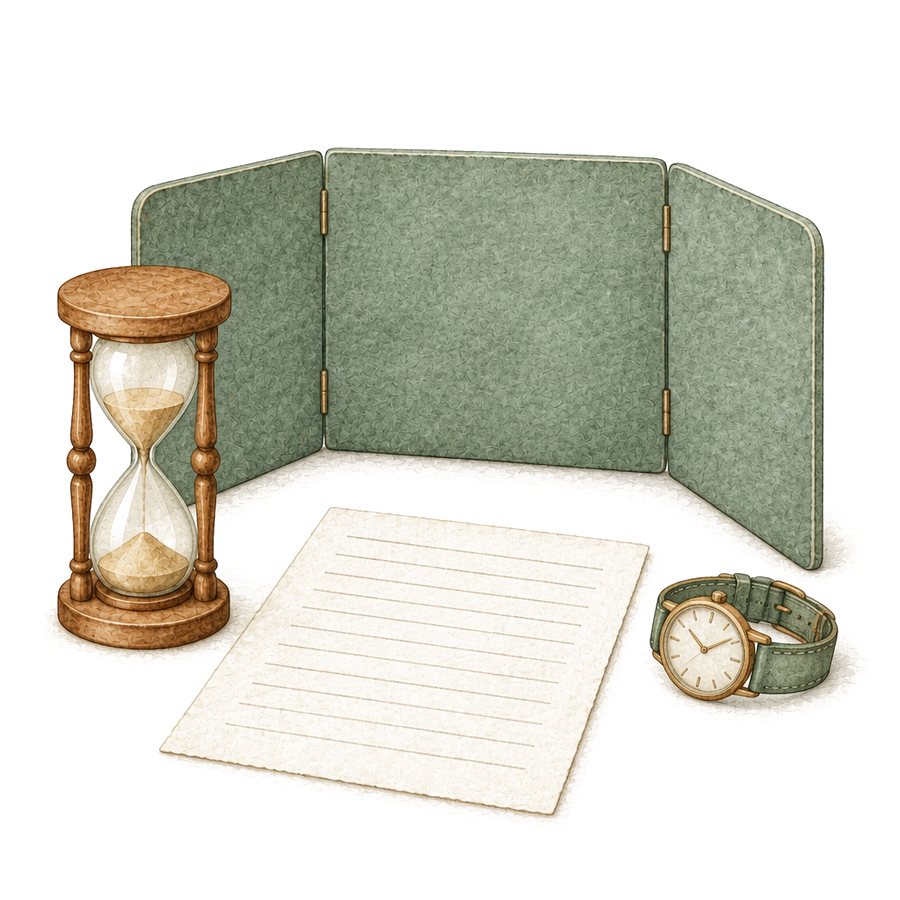
A spot with few distractions and little noise can work, and so can a separate room. For autistic students, headphones, a divider or a screened-off workspace can make a big difference as well. The National Autistic Society names strip lighting, noise, smells and a supervisor walking around the room as typical distractions during exams. Keep headphones an offer, not a rule: anyone who needs a pair can grab one, and nobody has to.
-
3. One task per page
The content stays exactly the same, only the layout changes: one task per page or per section, with plenty of white space around it. Students with ADHD do better with short, clear tasks and few distractions. With autistic students, take a second look at how each question is worded. Does it really ask what you mean? Rephrasing a question while keeping the same expectation can be what finally makes the task clear.
Class participation, and a few pitfalls you can skip
For many autistic students, having to speak up on the spot in front of the whole class is a real hurdle. What helps is making the process predictable, whether that's a speaking order, an agreed number of times to raise a hand, or response cards. When students know their turn is coming, they can get ready for it.
A few common mistakes are easy to sidestep. Don't lower the level, because then it's no longer an accommodation. Don't rely on verbal agreements either, since without anything in writing things get tricky later on, for example with standardized tests or final exams. External exams often have their own process: for the SAT and AP exams, for example, students have to request accommodations and be approved by the College Board before testing, separately from the school's own plan. It's tempting to reuse what worked for one student with the next one, but every accommodation is tailored to the individual. And take a look at your school's rules, because they differ from place to place.

Download: What Helps Me on Tests
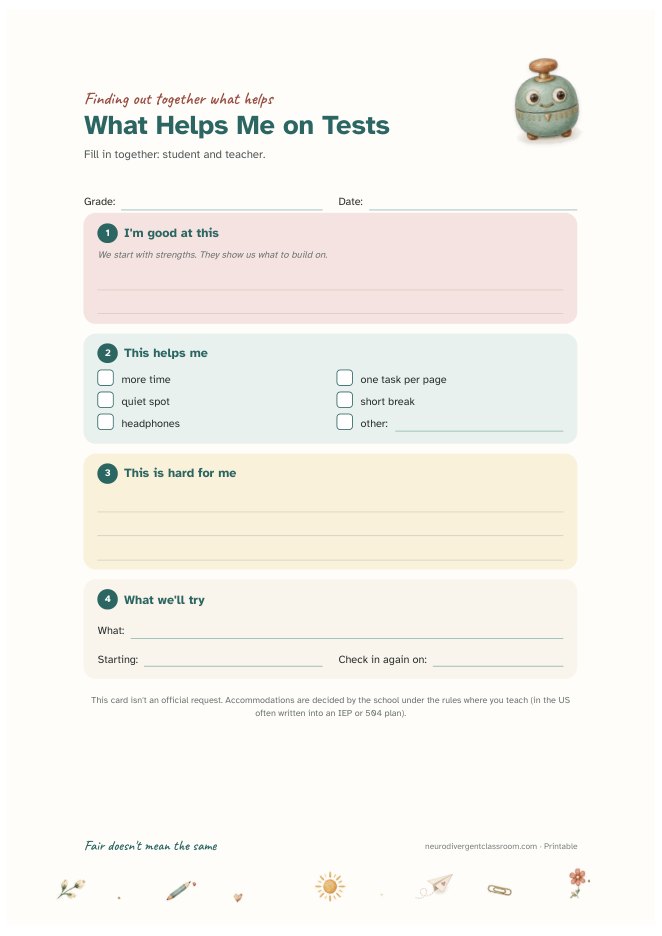
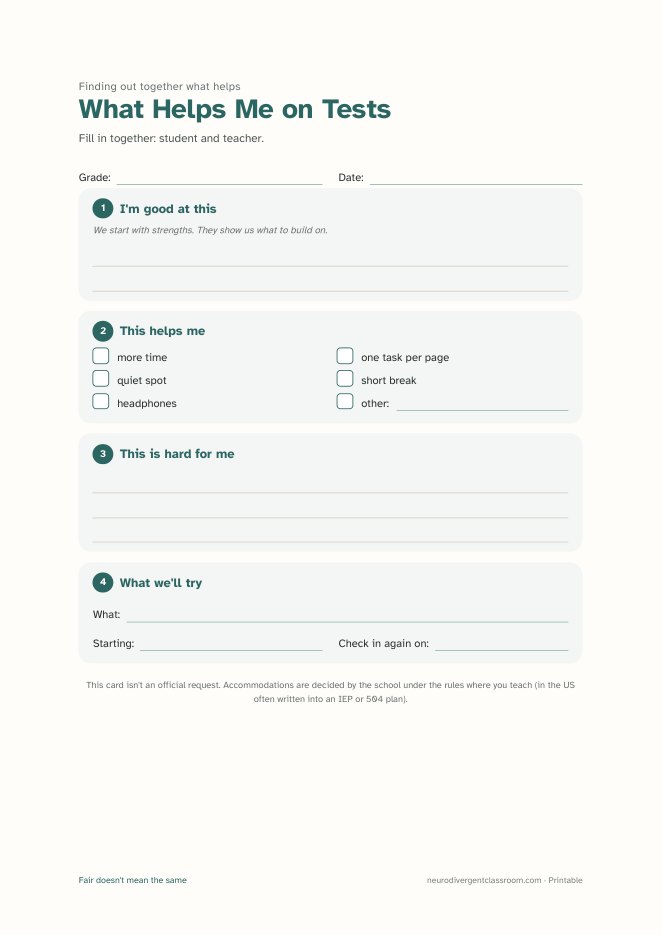
Fill out this printable together with the student, ideally at a calm moment when nobody's watching the clock. The checkboxes for more time, a quiet seat, headphones, one task per page and a short break get the two of you talking about what really helps. The boxes “This is hard for me” and “I'm good at this” make room for both the hurdles and the strengths, and under “What we'll try” you jot down what you'll test next. Just to be clear, the printable isn't a request or an application. Your school decides on accommodations according to its own rules.
Every printable comes in a colorful and a simple version. Choose the one you like to work with. Click the image to open the printable.
And one just for you
A page to take a breath and write things down, no lesson planning involved.

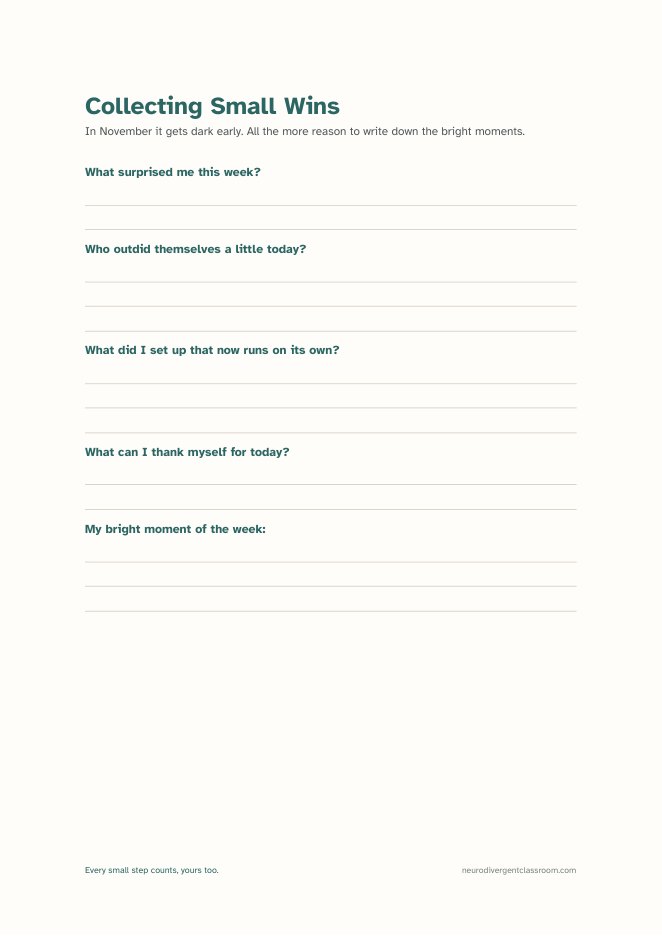
You will find these and all other printables collected in the Teacher Portal (members only).
You don't need to know every law to give a student good conditions. Often it all starts with one simple question: what helps you?
Sources
- Centers for Disease Control and Prevention: ADHD in the Classroom, as of June 1, 2026. IEP and 504 plan, common accommodations, research on accommodations still limited. Accessed November 14, 2026.
- Understood: The difference between IEPs and 504 plans. Accessed November 14, 2026.
- GOV.UK: Children with special educational needs and disabilities (SEND). SEN support and EHC plans in England, accessed November 14, 2026.
- NHS: ADHD in children and young people. Support at school through the SENCO, accessed November 14, 2026.
- Lovett, B. J., Nelson, J. M. (2021): Systematic review: educational accommodations for children and adolescents with attention-deficit/hyperactivity disorder. Journal of the American Academy of Child and Adolescent Psychiatry. 68 papers, abstract read.
- Miller, L. A., Lewandowski, L. J., Antshel, K. M. (2015): Effects of extended time for college students with and without ADHD. Journal of Attention Disorders. Abstract read.
- Bernard, J. L., Witmer, S. E. (2025): Examining how students with ADHD use an extended time accommodation on a low-stakes math assessment. Journal of Attention Disorders. Abstract read.
- National Autistic Society: Exams, a guide for teachers. Accessed November 14, 2026.
- College Board: Accommodations on College Board Exams. Accessed November 14, 2026.
- Lower Saxony Ministry of Education: Teaching Students on the Autism Spectrum. Basics, Notes, Recommendations (in German), legal status April 25, 2023, section 2.1.2, on predictable class participation, accessed October 17, 2026.